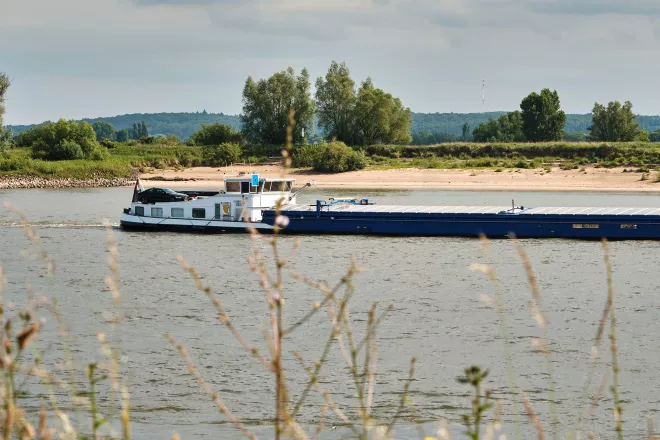

At its latest plenary session, the Central Commission for the Navigation of the Rhine (CCNR) adopted a temporary provision to regulate the use of track guidance assistants for inland navigation (TGAIN) on the Rhine. As a reminder, a TGAIN is navigation equipment fitted aboard a vessel for steering the vessel automatically along a track to follow.

New temporary provision in the Rhine Police Regulations (RPR)
The new temporary provision will come into force on 1 June 2026 and will apply until 31 December 2027 to vessels or convoys fitted with a TGAIN. This provision will facilitate better navigation safety pending the final regulations, which are due to come into force on 1 January 2028.
Technical standards relating to TGAINs are currently being adopted by the European Committee for drawing up Standards in the field of Inland Navigation (CESNI). In particular, these standards will set out the technical requirements for TGAINs, together with the conditions for their certification. The CCNR plans to use the CESNI standards as a basis for permanent changes to its legal framework. In the interim, the CCNR has deemed it necessary to amend the RPR to include a temporary provision. The future rules, which will apply from 1 January 2028, should cover both the use of the equipment and its technical requirements and certification.
What this new provision means for boatmasters
From 1 June 2026, all boatmasters of a vessel or pushed convoy fitted with a TGAIN must follow these requirements:
- Use the TGAIN as an aid to navigation: the boatmaster retains responsibility for the operation of the vessel at all times and must conduct regular checks to ensure that the TGAIN is functioning properly.
- Hold the necessary qualifications: the TGAIN may only be operated by a boatmaster who holds a valid certificate of qualification (or another certificate recognised as being equivalent). It may also be used for training purposes by another crew member, under the direct supervision of the boatmaster. In addition, if the TGAIN is used on sections which present specific risks or in reduced visibility, the boatmaster must hold the additional specific authorisations required for navigation on those sections or for radar navigation.
- The boatmaster must be present in the wheelhouse throughout the entire time the TGAIN is in use and must ensure that the awareness monitoring system is activated and that its alarm signal can be heard.
- Confirm the boatmaster’s presence at least every five minutes using the awareness monitoring system. As a reminder, this system is intended to monitor activity at the steering position and helps detect any incapacity that could lead to accidents.
- Deactivate TGAIN before entering a lock forebay: the boatmaster must deactivate the equipment in good time before arriving at a lock’s forebay. The equipment may only be reactivated after leaving the forebay.
- Ensure that the necessary operational data are recorded, in particular the activation/ deactivation of the equipment, any manual modifications to the track to follow and the commands entered. The use of TGAIN is only authorised if these data are recorded and stored for four days, so that they can be made available to the competent authority upon request (especially in the context of accident investigations). Article 4.08 of the RPR specifies the data to be recorded.
A specific context
This temporary provision is being adopted and entering into force at a time when an increasing number of craft are being fitted with TGAIN. Consideration is also given to the serious accidents that occurred recently at the locks at Iffezheim (Rhine) and Müden (Moselle), in which the use of this equipment played a role. The damage to the locks cost approximately €5 million per accident and had negative repercussions on inland navigation.
Points to remember
- The CCNR has adopted a temporary regulation concerning the use of track guidance assistants for inland navigation (TGAIN) on the Rhine.
- The new regulation applies to vessels or convoys fitted with a TGAIN which operate on the Rhine.
- This temporary provision will apply from 1 June 2026 until 31 December 2027. More permanent regulations governing the use and certification of the equipment are expected to follow.
- In particular, the boatmaster must follow these requirements:
- Use TGAIN as an aid to navigation;
- Hold the necessary qualifications;
- Be present in the wheelhouse, activate the awareness monitoring system and confirm the boatmaster’s presence at least every five minutes;
- Deactivate TGAIN in good time before entering a lock and its forebay;
- Ensure that the necessary operational data are recorded and stored for four days.

Other news from the CCNR

Plenary session of autumn 2025
On 4 December 2025, the Central Commission for the Navigation of the Rhine (CCNR) held its autumn plenary session in Strasbourg.
Read the press release
Priorities for the new Swiss Presidency for 2026-2027
From 1 January 2026 to 31 December 2027, Switzerland will hold the Presidency of the Central Commission for the Navigation of the Rhine (CCNR).
Read the press release
The CCNR publishes its Market Insight 2026
The new report on European inland navigation, drafted by the Central Commission for the Navigation of the Rhine (CCNR) in partnership with the European Commission, has just been published.
Read the press release