Introduction
For the CCNR (Central Commission for the Navigation of the Rhine), the principle of freedom of navigation has always gone hand in hand with the principles of organisation to guarantee the safety and proper functioning of navigation.
To this end, the CCNR has produced a number of technical rules in relation to the equipment and safety of vessels. The first Rhine Vessel Inspection Regulations (RVIR) dates back to 1905. This regulation has been continually updated to reflect technological progress. The inspection regulations have undergone substantial revisions over the years. The most recent significant revisions were carried out in 1976, 1995, 2006 and 2020.
The CCNR's regulatory powers are mainly based on Articles 1 and 22 of the Mannheim Convention. This regulation was drawn up in the 19th century in uniform fashion along the full course of the Rhine, with no discrimination between vessels.
Rhine vessel inspection regulations (RVIR)
The RVIR defines the basic premises on which the Inspection Bodies issue vessel certificates. In theory, the regulation is meant for the Inspection Bodies. In practice, the inspection regulations objectively define the technical conditions governing vessels on the Rhine.
Every vessel navigating on the Rhine must have a vessel certificate issued following examination by an Inspection Body. Any Rhine vessel can apply for a vessel certificate from any Inspection Body, regardless of nationality.
Field of application
The RVIR applies to
- vessels having a length (L) of 20 m or more;
- vessels for which the product of length (L), width (B) and draught (T) is equal to or greater than a volume of 100 m3;
- tugs and pushers, intended to tow or to push or to move alongside vessels or floating equipment;
- vessels in possession of an approval certificate in accordance with the ADN;
- passenger vessels;
- floating equipment.
Structure of the RIVR
Chapter 1. General
Chapter 2. Procedure
Annex A. Application for inspection
Annex O. List of certificates recognized as equivalent according to § 1.04 and modalities for their recognition
Application of the Rhine regulations across Europe
By virtue of its stringent requirements, factoring in cutting-edge technology, the RVIR has become Europe's technical reference base for the construction of new vessels, irrespective of whether they are intended for use on the Rhine or elsewhere. The regulation has been partly or fully incorporated into other national regulations (Germany, Hungary, Netherlands,), by UN-ECE (for the development of technical requirements for vessels, Resolution 61 revised), and by the European Union (Directive 2006/87/EC 


 ).
Directive 2006/87/EC thus enabled the harmonisation of the technical requirements laid down for EU waterways (zone 3) with those of the Rhine (RVIR).
On the basis of this equivalence of technical requirements, in 2007 the CCNR recognised the validity of Community certificates on the Rhine (Protocol 2007-II-21 ), while Rhine inspection certificates have also been recognised on all EU waterways. In future, Rhine and EU regulations will evolve in tandem so as to remain identical.
This alignment of CCNR and EU requirements continued in 2015 with the creation of the CESNI and the adoption of the European Standard laying down technical requirements for inland navigation vessels (ES-TRIN). The standard is available in four languages (Dutch, English, French and German) and contains a harmonised version of the requirements of the Rhine Vessel Inspection Regulations and those of the Directive 2006/87/EC. It contains provisions on the construction, fitting out and equipment of inland navigation vessels, special provisions for particular types of vessel, such as passenger vessels and container ships, provisions relating to the model inland navigation vessel certificate and instructions on the application of the technical standard.
References to the ES-TRIN have now been incorporated into the legal frameworks of the CCNR and the EU, respectively the Rhine Vessel Inspection Regulations and the Directive (EU) 2016/1629, which replaced Directive 2006/87/EC. This common standard applies to the Rhine and to the entire inland waterway network of the European Union.
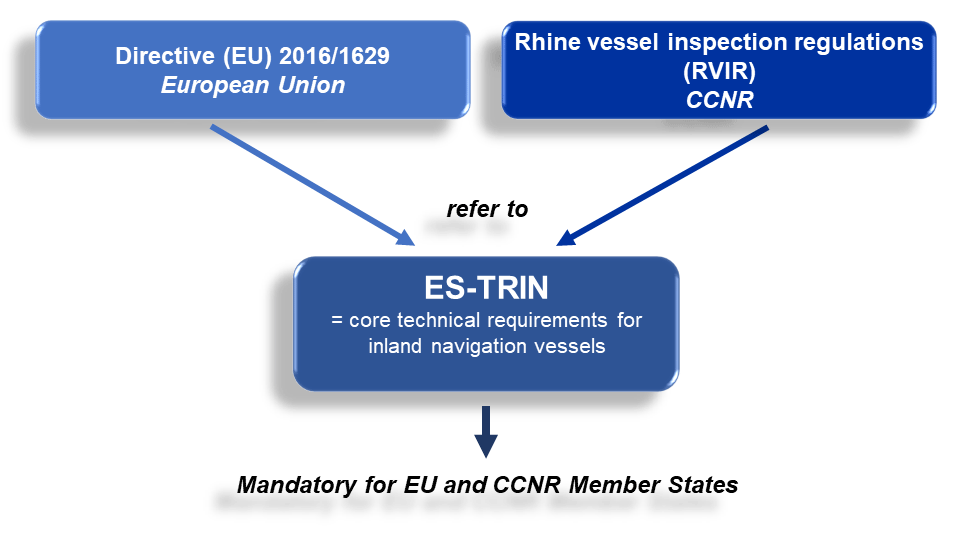
The various editions of the ES-TRIN are available on the website of the European Committee for drawing up standards in the field of inland navigation (CESNI).
Overall, this technical regulation is stringent while also allowing for flexibility. The stringency is demonstrated by the fact that the requirements are the strictest and the most technically advanced. Its flexibility can be seen in the range of implementation options, such as transitional provisions, so as to take account of the vested rights of existing vessels.
Recommendations to the inspection bodies
On the basis of recommendations from the CCNR, an Inspection Body may issue an inspection certificate containing a waiver from the technical requirements of the ES-TRIN.
Such waivers may relate to:
- the use, or presence, on board a vessel of certain materials, installations or items of equipment, or the adoption of certain design aspects or certain arrangements other than those prescribed by the ES-TRIN;
- a case where compliance with certain requirements of the ES-TRIN is difficult to achieve in practical terms or gives rise to unreasonably high costs (“hardship clause”); or
- the testing of new technical arrangements that derogate from the technical requirements of the ES-TRIN.
This question is regulated in detail under Article 2.20 RVIR.
The information below is intended solely to explain the procedure and does not prejudge any decisions or additional requests made by the CCNR when examining a request for a recommendation.
The CCNR regularly publishes recommendations to the Inspection Bodies.
Submission of the request and examination by the Inspection Regulations Working group
The CCNR has delegated the authority to decide upon recommendations to its Inspection Regulations Working group.
The project owner must first contact the Inspection body which will issue the Rhine Vessel Inspection Certificate (RVIC).
Requests for recommendations are examined by the Inspection Regulations Working group on the proposal of the delegation of the State which will issue the RVIC. This delegation is responsible for checking the completeness and quality of the request for recommendation. It assists the project owners, advises them and supports them in preparing their request for a recommendation. It is the sole point of contact between the Secretariat and the project owner.
Content of the documents for requesting a recommendation
To enable the CCNR to examine the request, the application file shall contain at least:
- a description of the vessel project or the vessel together with the ES-TRIN articles from which a derogation is planned;
- the proof of an equivalent safety level.
The rest is to be submitted as a function of the recommendation requested. For example, for propulsion systems using new energy sources, this file will also include a risk assessment, a general plan and other relevant plans, the bunkering procedure and training of the crew.
The summary project description shall be around 5-10 pages and contain at least the following information:
- developer(s) of the project, incl. contact data,
- supplier(s) of the corresponding parts,
- owner(s) of the vessel,
- specific articles from which a derogation is requested,
- reason, why a derogation from the ES-TRIN is necessary,
- if appropriate, a description of the operation profile, including intended area of operation and cargo.
In addition, documents proving the equivalent safety level must be submitted. The risk mitigation measures to be applied for the specific articles for which a derogation is requested must be indicated. This may be in the form of an explanation supported by drawings, an expert’s report, a certificate from the classification society or a complete risk assessment.
For projects with alternative fuels, if a risk assessment is used to demonstrate the equivalent safety level, it must comply with the requirements of Article 30.04 of the ES-TRIN (especially the type of analysis and the list of risks). The impact of the innovative element on the overall safety of the vessel is verified by the risk assessment).
Only the draft recommendation and the summary description of the project (about 5 to 10 pages) will be translated into French, German and Dutch. The other elements of the dossier must be provided in English by the delegation submitting the project.
Period of validity
In accordance with Article 2.20 of the RVIR, recommendations are issued:
- For an unlimited period of time if the request for a recommendation concerns the derogations referred to in (1) (“the use, or presence, on board a vessel of certain materials, installations or items of equipment, or the adoption of certain design aspects or certain arrangements”) or (2) (“taking into account the specific safety needs of persons with reduced mobility” or “the provisions of Chapter 32 of the ES-TRIN, following the expiry of the transitional provisions”) or (6) (“vessel converted to a length of more than 110 m”) of Article 2. 20 of the RVIR.
- For a limited period of time if the request for a recommendation concerns the derogations referred to in (3) of Article 2.20 of the RVIR (“new technical arrangements that derogate from the technical requirements of the ES-TRIN”).
Bodies
The technical requirements for vessels are drawn up by the Inspection Regulations Committee (RV) and its Inspection Regulation Working group (RV/G).
Its primary tasks are:
- to amend the RVIR to reflect current developments or experience;
- to cooperate with the European Commission in the field of technical requirements;
- to reduce polluting emissions from the engines of inland navigation vessels;
- to draft recommendations concerning derogations.
Every two years, the RV Committee defines a work programme setting out the priorities and future tasks.
The RV Committee traditionally meets twice a year, in Strasbourg (see the meeting calendar).
Chair of the Committee: Mr Ivo TEN BROEKE, Commissioner for the Netherlands
Secretariat: Mr Benjamin BOYER, Administrator responsible for matters relating to vessel technical requirements.
Joint meetings of the inspection bodies
The experts from the Inspection Bodies of the Member States of the CCNR meet regularly. Since 2008 they have held joint meetings with the experts from the Inspection Bodies of EU Member States . Their aim is to harmonise the application of the technical requirements and to answer questions concerning their practical application. The last meetings took place in Vienna in 2018 and in Zagreb in 2023, both under the auspices of the CESNI.