Description of the study
If it is to achieve the major environmental aims set out in the Mannheim Declaration


 , the inland navigation sector will need new, up-to-date financial instruments. Thus far, the existing financing and subsidy mechanisms have not been able to deliver the desired results.
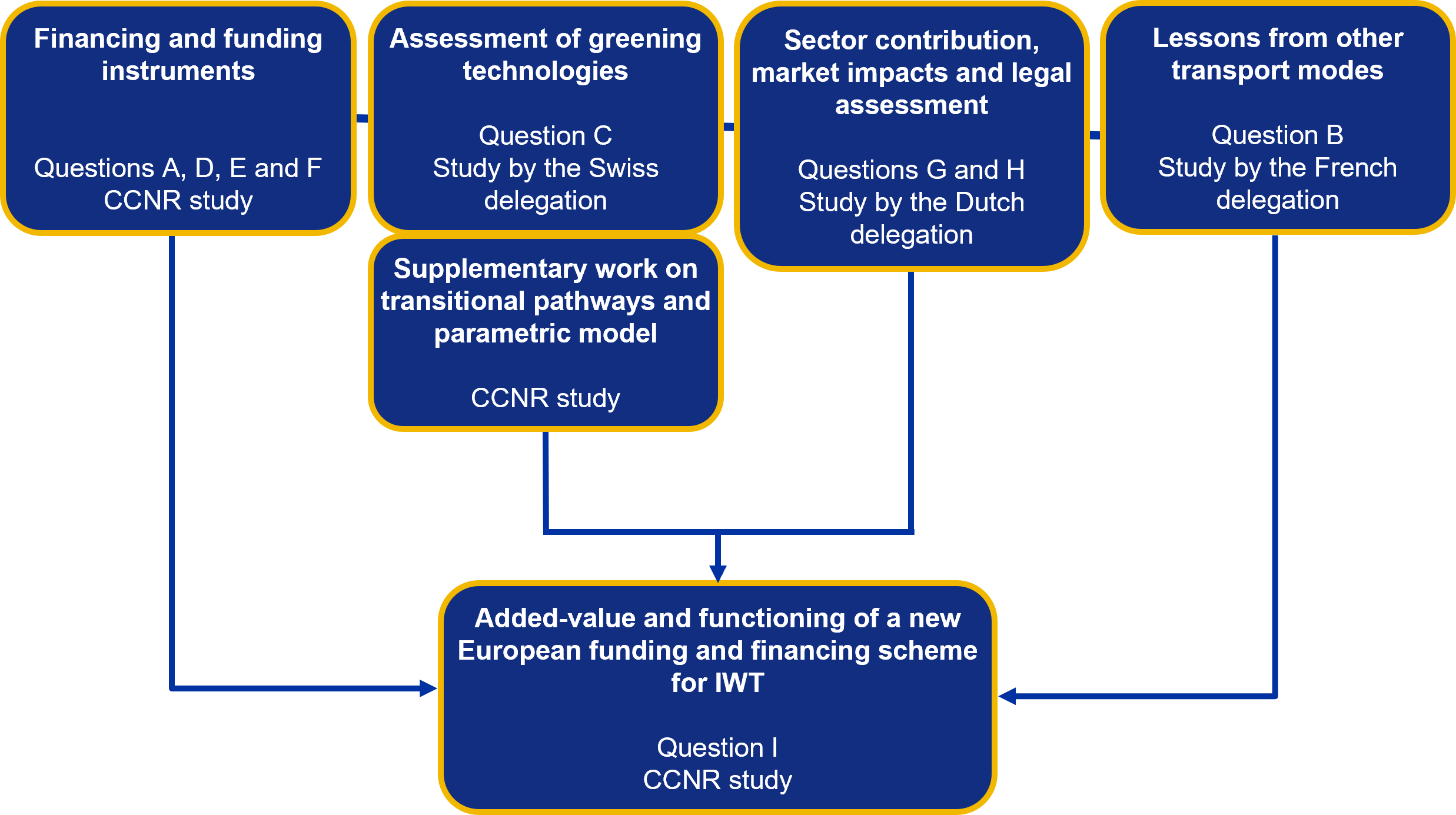
In order to accomplish this task, a study was launched. Its aim was to provide answers to the following questions:
- What are the possible triggers and financial drivers to enable a positive investment decision by shipowners to invest in technologies contributing to zero-emission performance?
- What can we learn from other transport modes?
- Which greening techniques fit into zero-emission development of IWT and what are the impacts?
- What is the potential of pay-per-use and leasing schemes for the IWT market?
- What is the potential of joint procurement?
- What can be expected from national and European programmes and products providing funding and financing?
- What is the potential for polluter pays schemes in IWT?
- What are the requirements and boundaries considering level playing field and modal share?
- What is the added value of a new European funding and financing scheme for IWT and how could this work?
- What accompanying measures and follow-up steps are needed? (not addressed)
Taking a preliminary study carried out by the EICB (Expertise- en Innovatie Centrum Binnenvaart) as the basis, a start was made on conducting this study.
Main results of the preparatory study
In May 2019, the in-depth study was launched by the Central Commission for the Navigation of the Rhine (CCNR), the Netherlands and Switzerland. The aim was to answer the various questions that had been identified.
The main objectives of this study were:
- to formulate recommendations for the development of a European funding and subsidy system to support the energy transition in the sector,
- through this, to pave the way for a political decision based on the evaluation and, where appropriate, implementation of the study's conclusions.
Final results
On 3 June 2021, the CCNR approved the publication of the final results of the study (Resolution 2021-I-6). The results do not pre-judge the position of the Central Commission or the Member States.
In adopting this resolution in its plenary session, the CCNR primarily emphasised the fact that the energy transition represents a crucial challenge for the Rhine and for European inland navigation. Furthermore, it also involves technical uncertainties and considerable costs, estimated at several billion euros. These costs cannot be borne solely by the sector. The study therefore proposed that a funding instrument be developed, based on public and private sources, including a contribution by the sector.
On the basis of this study, in its roadmap for the reduction of emissions the CCNR also undertook to examine the possibility of a contribution from the sector within the framework of such an instrument and to work towards implementing this concept. The CCNR thus requested, for the end of November 2021, a detailed legal analysis to determine whether imposing a contribution to a greening fund for inland waterways would be compatible with the Mannheim Act. In December 2022, the CCNR also launched a consultation with the inland waterways sector in order to understand the profession’s position on the concept. The concept was then refined as part of the PLATINA3 project.
To date, no consensus on the introduction by the CCNR of such a financing instrument has been found, for various economic, legal and political reasons (complexity of the instrument, unrealistic short-term implementation, doubts about the efficiency of such an instrument, possible incompatibility with the Mannheim Act, lack of consensus on industry participation, lack of political consensus, etc.). In addition, while an in-depth analysis on this concept was being carried out by the CCNR, Europe faced a pandemic, a changing geopolitical context and an energy crisis leading to an increase in fuel prices. In 2024 and 2023, fuel prices were respectively 44% and 54% higher than the pre-energy crisis levels recorded in 2021.
The launching of the European Union “Fit for 55” Package (COM(2019) 640) also put an end to the momentum for such a contribution, with many initiatives which would come as an additional financial burden for the sector, for instance:
- the proposal for a revision of the EU directive on Energy Taxation (EC proposal of 14 July 2021 - COM(2021) 563), which made the risk of a tax on diesel in parallel to a sector contribution a reality, although diesel is currently exempted from tax on the Rhine;
- the directive on energy from renewable sources (RED III – Directive (EU) 2023/2413), which imposes the obligation to reduce greenhouse gas emissions, in particular on suppliers of fuel to inland navigation vessels, which could affect fuel prices. The Directive gives Member States the choice of reducing by 14.5% the greenhouse gas intensity of transport fuels or achieving an overall rate of 29% of renewable energy in final energy consumption across all transport sectors;
- the possibility foreseen in the EU Emissions Trading System Directive (Directive (EU) 2023/959) to apply the ETS to inland navigation from 2027 onwards.
In this context, the merits of such a contribution, as well as the signal that it would send to the sector, were called into question. Nevertheless, it is clear that solutions must be found to encourage inland navigation companies to make investments in favour of this energy transition, and also that funding for inland navigation is required in this respect. The CCNR therefore remains a forum for exchanging information between Member States regarding national decisions on financing and funding instruments as well as to coordinate positions related to the financing of the inland navigation sector. The CCNR has already begun to approach the EU in order to improve the suitability of existing and future funding and financing opportunities for inland navigation.
Furthermore, the results of the study are still being used by the various stakeholders in the sector in their discussions with national and European decision makers, in order to emphasise the need to support the river sector in its energy transition.
Documents
Reference documents
Main results of the preparatory study
Final study report on the overall study project and the final conclusions that can be drawn from the work carried out.
- Deliverable A on the possible triggers and financial drivers to enable a positive investment decision by shipowners to invest in technologies contributing to zero-emission performance.
- Deliverable B on the lessons to be learnt from other modes.
- Deliverable C (Edition 1) on the technical and economical assessment of greening techniques which fit into zero-emission development of IWT.
- Deliverable C (Edition 2) complementing the findings from Edition 1 in order to come up, in particular, with more refined transition pathways towards zero emission.
- Deliverable D on the potential of pay-per-use and leasing schemes for the IWT market.
- Deliverable E on the potential of joint procurement for the IWT market.
- Deliverable F on the expectations from national and European programmes and products providing funding and financing.
- Deliverable G et H on the potential for polluter pays schemes in IWT and the requirements and boundaries considering level playing field and modal share.
- Deliverable I on the added value of a new European funding and financing scheme for IWT
Disclaimer: The conclusions presented in this study and opinions expressed, are those of the authors and do not necessarily also represent the position of the CCNR on the subject in question. Use of the knowledge, information or data contained in this document is at the user’s own risk. The CCNR shall in no way be liable for use of the knowledge, information or data contained in this document or any ensuing consequence.
Other documents
Presentations
- Presentation of the Secretary General of the CCNR on the intermediary results of the studies – Ministerial Conference on Inland Navigation under the German Presidency of the Council of the European Union (20.11.2020)
- Presentation of Ulf Körschgen, CCNR Commissioner, Swiss delegation, on the intermediary results of the study - PLATINA3 1st stage event, Budapest (07.04.2021)
Legal opinion (11.2021)
- Introductory note accompanying the publication of Prof. De Decker's legal opinion
- Executive summary
- Legal opinion on the levying of an energy tax at a minimum rate or contribution to a greening fund applicable to waterways falling within the scope of the Revised Convention for Navigation on the Rhine
Partners and stakeholders
Authors of the studies
- Central Commission for the Navigation of the Rhine (CCNR)
- Dutch Ministry of Infrastructure and Water Management
- Federal Department of the Environment, Transport, Energy and Communications - Federal Office of Transport (FOT)
- Ministère de la transition écologique
- Cerema
- DST
- ECORYS
- EICB
- PANTEIA
- PRODanube
- Rebel
Contributing partners and stakeholders
- Danube Commission
- European Investment Bank (EIB)
- European Commission (DG MOVE)
- European Investment Advisory Hub (EIAH)
- Mosel Commission
- CLINSH
- European Barge Union (EBU)
- European Shippers’ Council (ESC)
- European Skippers Organisation (ESO)
- European Federation of Inland Ports (EFIP)
- IWT-Platform
- Shipyards and Maritime Equipment Association of Europe (SEA Europe)
- Association for Inland Navigation and Navigable Waterways in Europe (VBW)