
The Central Commission for the Navigation of the Rhine (CCNR) has a hierarchy of decision-making and working bodies.
Plenary meeting
The CCNR holds two plenary sessions per year, in spring and in autumn. It consists of representatives from the Member States. Each State may appoint four full commissioners and two deputy commissioners. Delegations may also include a delegation secretary and national experts.
The plenary meeting is the decision-making body of the CCNR. It adopts the resolutions of the Central Commission. Each State has one vote. Decisions are taken unanimously. The Presidency rotates among the Member States, with a two year mandate.
In some cases, the plenary meeting has delegated the power of decision on certain matters to its committees.
Observer States and international organisations with observer status are invited to attend the plenary meetings.
Committees and working groups
The resolutions for the plenary session are prepared by the committees and the working groups. They form the real backbone of the Central Commission.
There are around 20 committees and working groups, whose members are drawn from all five of the Member States.
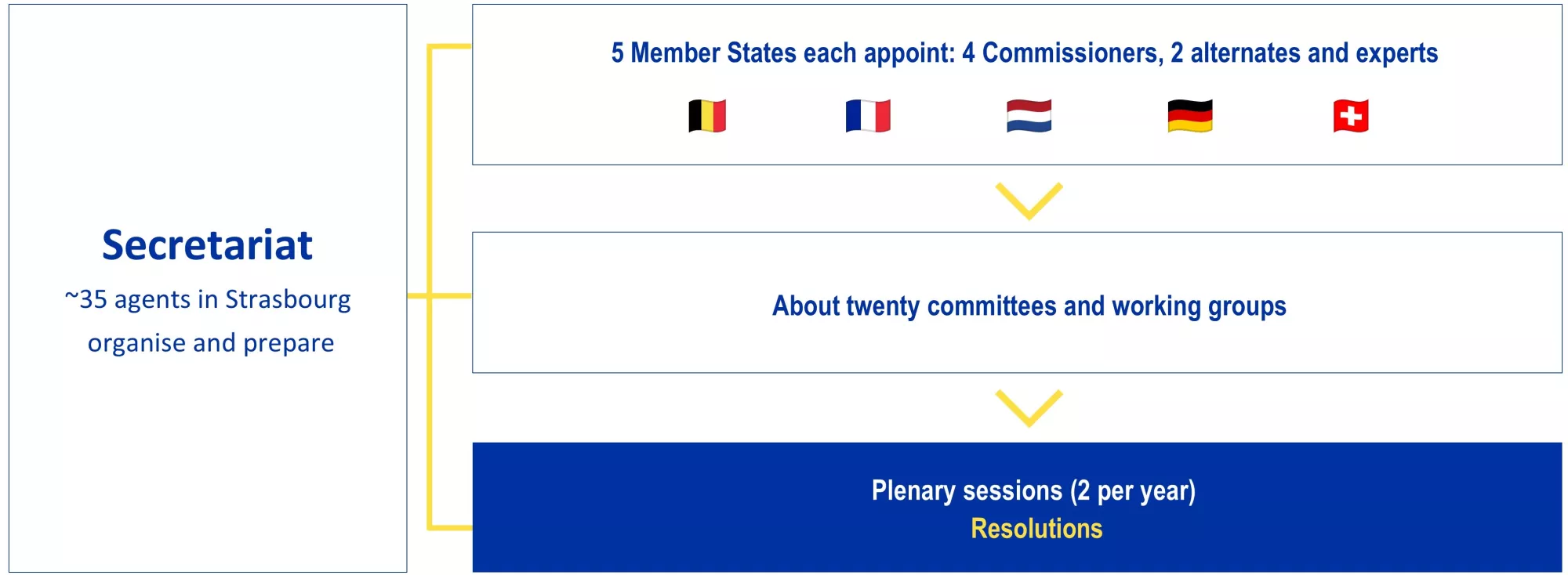
In principle, the committees comprise at least one full commissioner or deputy commissioner from each Member State, together with the experts designated by the States. They usually meet twice a year, though it can be more often. In some cases, the work of the committees is prepared by the working groups. The composition of the working groups depends on the tasks allocated to the group and may also include qualified external experts.
Observer States are invited to take an active part in the work of the committees and working groups. Approved non-governmental organisations may be consulted by the committees or participate in the working groups.
The work caried out by the committees and working groups is prepared by the delegations, approved organisations and the Secretariat. Thanks to the contributions of these different actors, most of the drafts elaborated by the committees and working groups are prepared in a spirit of consensus. This consensus facilitates effective decision-making at the plenary meetings, bearing in mind the requirement for unanimity.
In addition, the CCNR has two special bodies:
- The Appeals Chamber consists of five judges and five alternate judges – one judge and one alternate from each CCNR Member State. Parties may choose to lodge an appeal with either the competent national Court of Appeal or the Appeals Chamber, which has final jurisdiction in both criminal and civil cases.
- The CESNI (European committee for drawing up standards in the field of inland navigation) was established in 2015 by a resolution adopted by the CCNR. International and European regulations, especially those of the CCNR and the EU, can refer to these standards, with a view to their application. The creation of this new working body demonstrates the wish of the CCNR, which it shares with the European Union, to harmonise inland navigation policy at European level. The Committee brings together experts from the Member States of the CCNR and the European Union, as well as representatives of international organisations involved with inland navigation. The Secretariat of the CCNR also acts as the Secretariat for CESNI.
Other bodies
The CCNR Secretariat manages activities relating to inland navigation and supports the work of specific conventions:
- The CDNI (Convention on the collection, deposit and reception of waste generated during navigation on the Rhine and other inland waterways) was negotiated within the framework of the CCNR. It entered into force on 1 November 2009 in Belgium, Germany, France, Luxembourg, the Netherlands and Switzerland. It aims to protect the environment, especially water. The CCNR Secretariat acts as the Secretariat for the CDNI.
- The CASS (Central administration of social security for Rhine boatmen) was established on the basis of a tripartite structure. Each national delegation consists of two governmental representatives, one representative of Rhine navigation employers and one representative of salaried employees. The main responsibility of the Administrative Centre is to address any issues concerning interpretation or application of the provisions defined in the Rhine Agreement on social security for Rhine boatmen and the Agreement on determination of legislation applicable to Rhine boatmen, concluded on the basis of Article 16(1) of Regulation (EC) 883/2004 (“Derogation agreement”).
- The CLNI (Convention on the limitation of liability in inland navigation), adopted in 1988, is based on the model of the LLMC (Convention on limitation of liability for maritime claims). It enables the owners and crew members of vessels, their assistants and their salvors to set a maximum limit for their liability in respect of a large number of claims made in connection with a single incident. In 2007, the contracting States to the CLNI 1988 decided to revise the convention, culminating in CNLI 2012.
Meetings
In principle, meetings are held in Strasbourg, but may also take place elsewhere. Every year there are over 70 meetings. All work is conducted in the three working languages of the CCNR: German, French and Dutch. English is also an official CCNR language and is used in certain contexts.
Rules of procedure
The CCNR has drawn up a set of rules of procedure setting out how it and its various bodies operate. The rules of procedure were adopted by resolution.