The importance of the Rhine
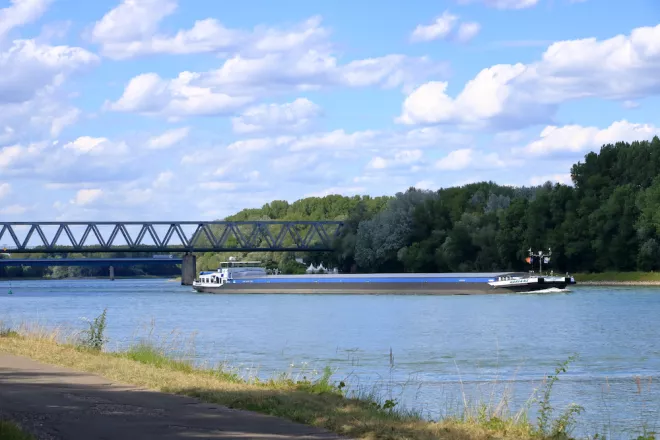
The Rhine, which stretches for 1,232.7 km, is one of the most important and best-known rivers in Europe. Over 60 million people live and work in its catchment area. As well as many other roles, it is a very busy inland waterway. There are many towns, recreational areas, industrial centres and agricultural zones located along the banks of the river.
The Rhine, which is at the heart of the European river network, is navigable over a length of 884 km, from Rheinfelden (near Basel) to the North Sea. It flows through Switzerland, France, Germany and the Netherlands.
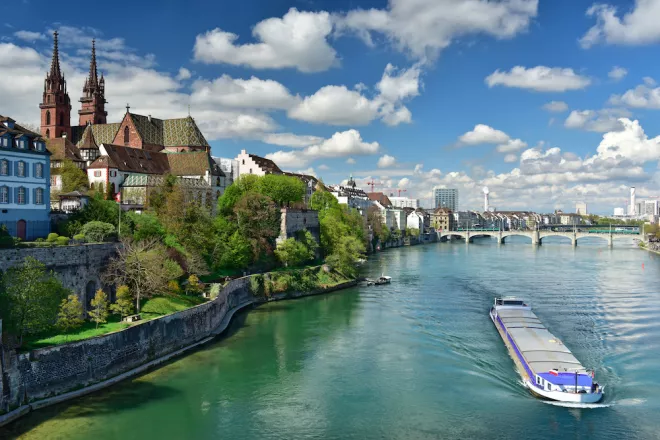
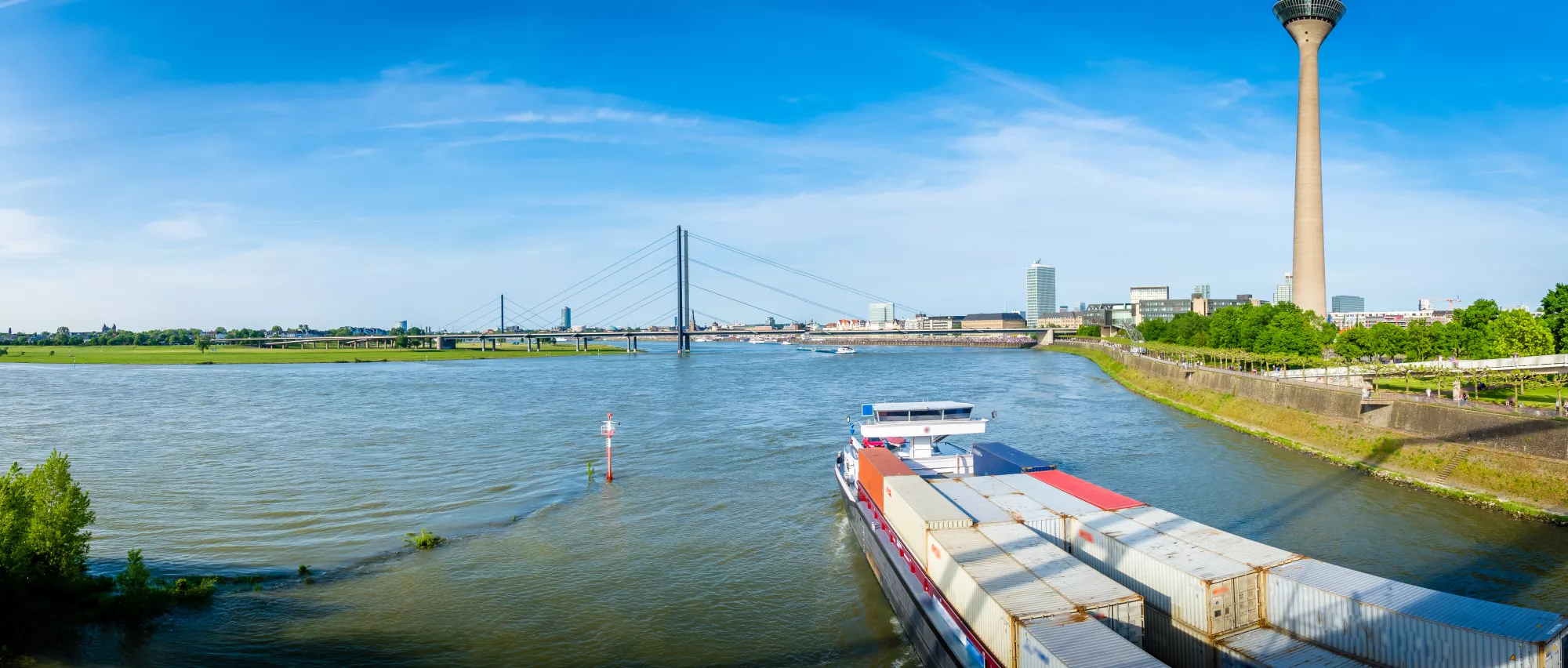
For Switzerland and France, the Rhine offers an important link to the world market via the seaports of Rotterdam and Antwerp. With the metropolises of Basel, Strasbourg, Mannheim/Ludwigshafen, Cologne and Duisburg, the Rhine flows through important industrial and economic areas, and with the Rhine-Ruhr region even through Germany's largest industrial conurbation. Two parallel canals connect the Ruhr region with the Rhine: the Rhine-Herne Canal, which branches off near Duisburg, and the Wesel-Datteln Canal, 30 km to the north. Shortly after Emmerich, the Rhine flows through the Netherlands and into the southern North Sea in an extensive delta. The major seaports of Amsterdam, Rotterdam and Antwerp have settled in the Rhine delta. They are the first European ports of call for ships from overseas. The Rhine offers them an excellent hinterland connection to central Europe.
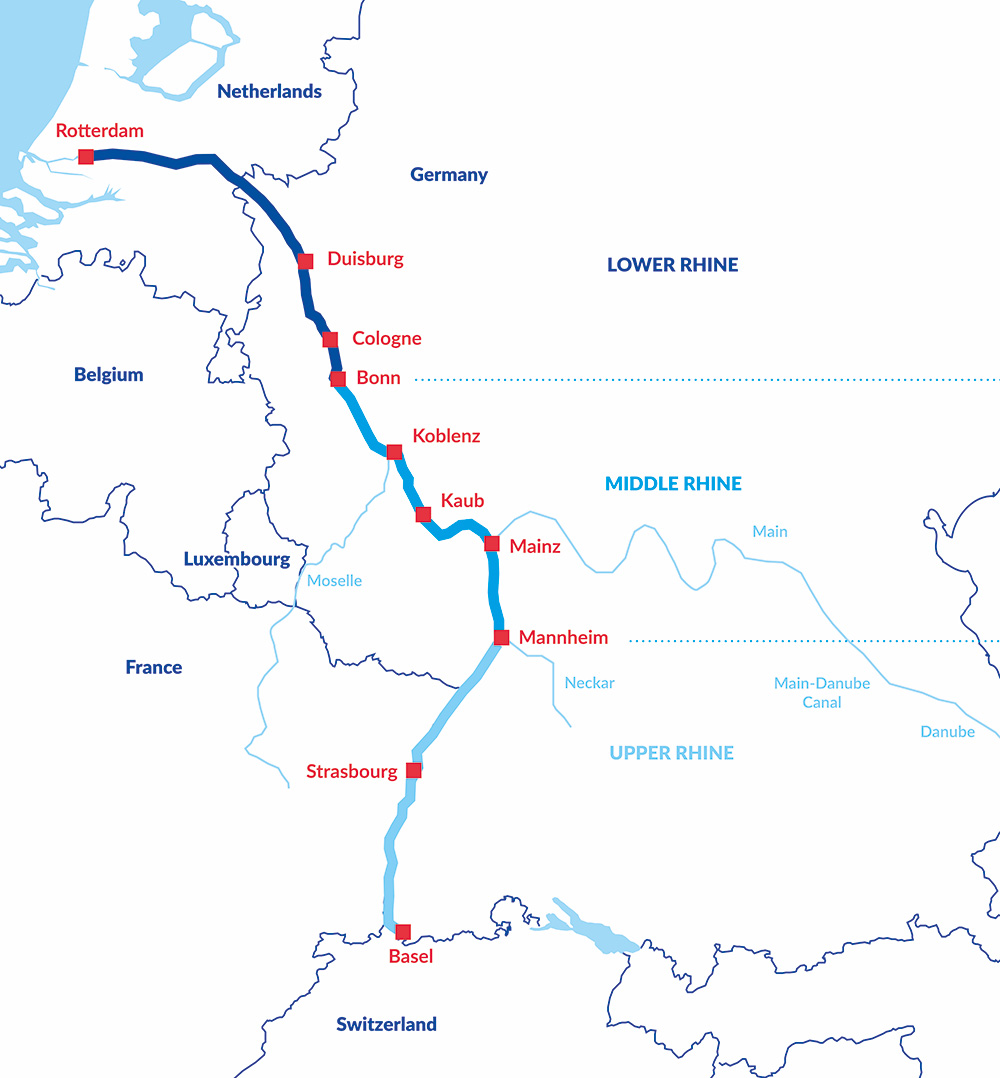
The Rhine is one of the world’s busiest inland waterways and the most important and most modern in Europe. The Rhine is an integral part of the European inland waterways network, where it forms the main artery. The Rhine is also at the heart of European transport flows and is connected to other modes of transport, such as rail. In particular it is integrated into the North Sea–Rhine–Mediterranean European transport corridor (NSRM).
Goods transported on the Rhine
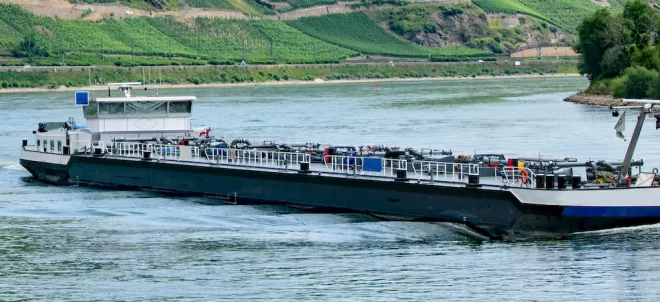
The Rhine carries 60% of the goods transported by river in Europe, amounting to around 300 million tonnes per year, either in containers or as bulk or liquid cargo.
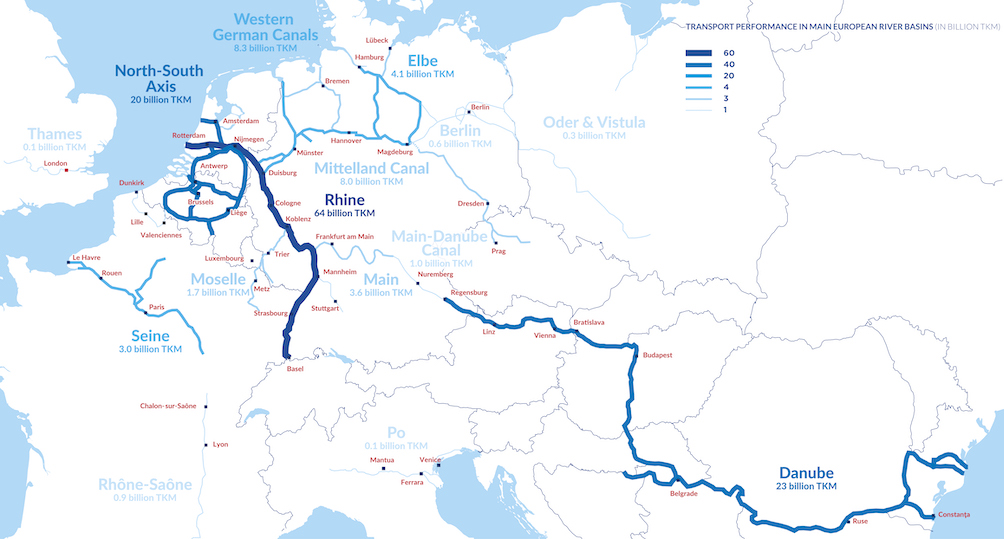
Source: Market observation/Annuel report 2025, CCNR and European Commission.
Figures for the Po are from 2022, figures for the Thames are from 2023, the others are from 2024. CCNR analysis based on Destatis, VNF, Eurostat [iww_go_atygo], UK Department for Transport.
Of the 13,400 cargo vessels in Europe, 9,200 are registered in the Rhine States. These 9,200 vessels represent a fleet capacity of 13,700,000 tonnes (2024 figures). To give an indication, every day there are around 300 vessels operating on the Lower Rhine and about 60 in the Gambsheim sector (on the French-German border).
The figure below illustrates the distribution of the volume of goods:

The advantages of inland navigation
The CCNR continues to use all means at its disposal to promote and strengthen inland navigation as a high-performance, environmentally friendly mode of transport that still has a significant unexplored potential. This policy applies to the Rhine but also in a wider European and international context.
Inland and Rhine navigation offer a number of advantages:
- It is a sustainable mode of transport. At a level comparable to rail transport, inland navigation in Europe accounts for the lowest share of GHG (greenhouse gas) emissions (0.5%) relative to the total amount of GHG produced by transport.
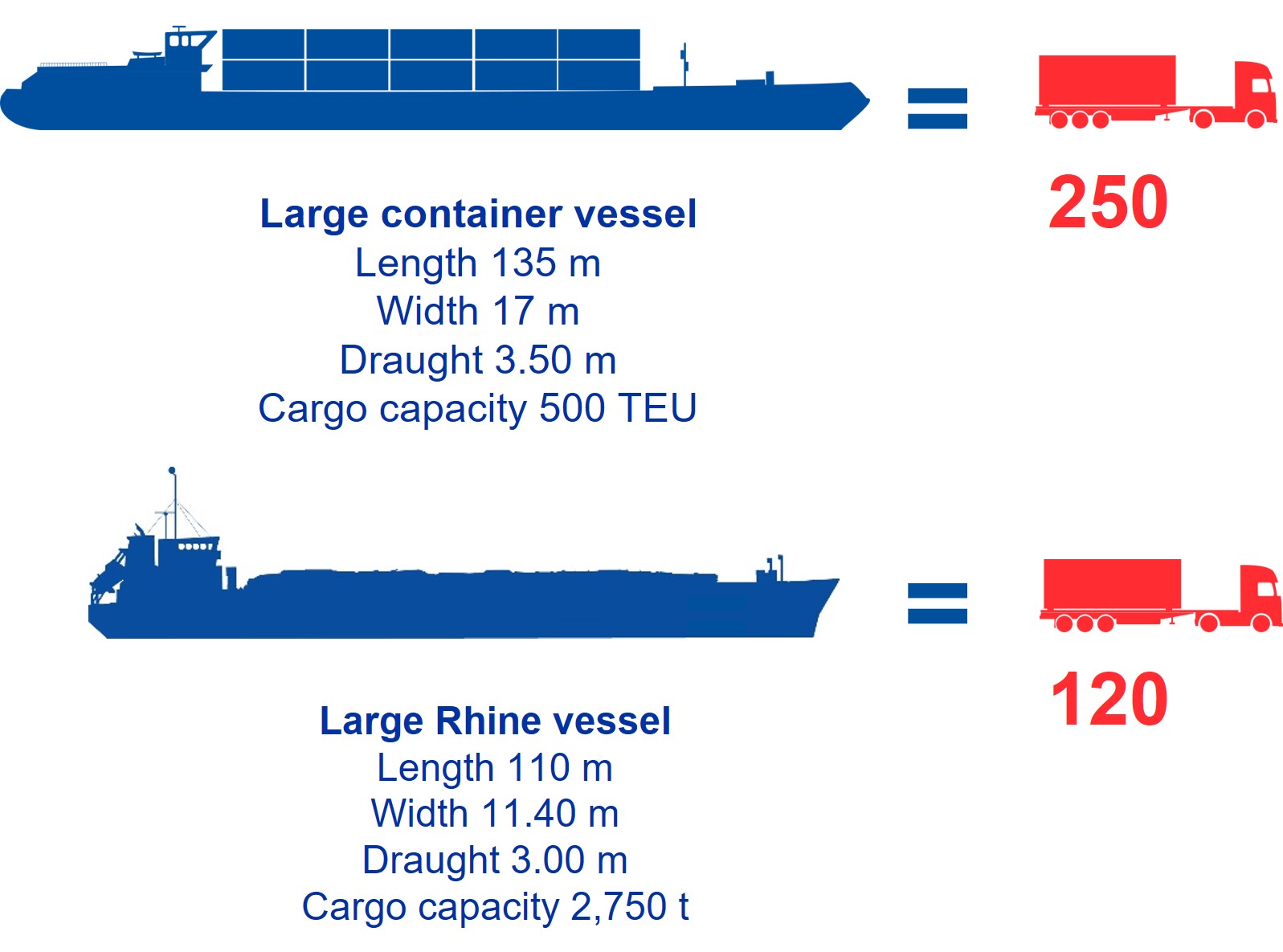
- It is a low energy mode of transport. A large vessel on the Rhine, with a load capacity of 2,750 tonnes, is equivalent to 120 trucks. A large container vessel, with a capacity of 500 TEU equates to 250 trucks.
- As urban areas offer easy access to inland navigation vessels, the number of traffic jams can be reduced.
- Inland navigation allows an increased consolidation of goods flows. It is also an essential link in the logistics chain for the transport of large volumes of goods such as petroleum products, chemicals, construction materials and cereals.
- Inland navigation is a safe mode of transport. There are very few accidents or casualties, especially when compared with road transport.
- Europe has a dense, international and interconnected network of navigable waterways.
- The Rhine, along with other European waterways, still has great unused capacity, offering significant potential for the modal switch.
Despite the many advantages offered by inland navigation, it currently accounts for only 5% of the market of the various modes of transport within the EU-27 (internal transport). Road transport accounts for 78% and rail 17% (2023 figures).
Finally, inland navigation is facing a number of challenges, such as developing low emission propulsion techniques, automated navigation, integrating new information technology and adapting to climate change and periods with low water levels.
Useful links
Information relating to the Rhine waterway is available on the following websites: