
Organisation and competence
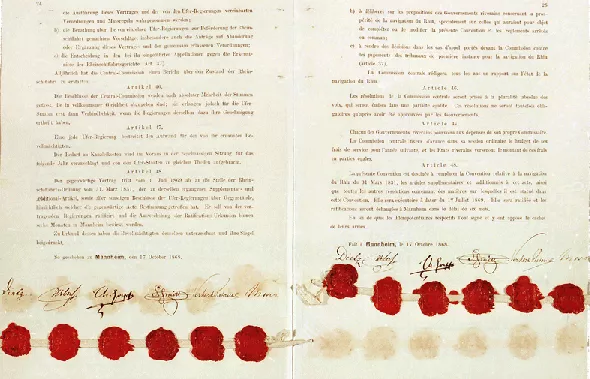
Under the terms of the revised Convention on Navigation on the Rhine (Mannheim Act)

 signed in Mannheim on 17 October 1868, the Member States of the CCNR agreed on the means of legal redress:
- in the event of a breach of the police navigation regulations, or
- in the event of a dispute relating to damage caused during navigation on the Rhine.
To this end, each Member State must designate the courts of first instance and the courts of appeal that have jurisdiction in such disputes.
An alternative to the competent national court of appeal was provided for in the Mannheim Act: appeals may also be lodged directly with the CCNR. This established a unique situation in which an international body has competence that is similar and in competition with that of the national courts of appeal.
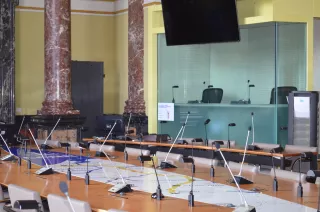
Until 1968, however, the Central Commission’s decisions were not true court judgments; they were prepared by the Secretariat and adopted unanimously by the Member States’ delegations at CCNR plenary sessions. It was only under the terms of the Strasbourg Convention of 20 November 1963, which came into force in 1967, that a true international court was established. It is composed of independent judges with acknowledged competence to deal with matters concerning inland navigation. The Chamber of Appeal adopted its initial Rules of Procedure on 23 October 1969 and delivered its first judgment on 23 June 1970.
Parties may lodge an appeal where the dispute exceeds the sum of 20 SDR (see the IMF website for further information: https://www.imf.org/). The place of payment, the place where the damage was caused and the place where the offence was committed are the criteria used to establish territorial competence. The parties may, however, agree to take their dispute before another Rhine navigation court or even another court or arbitration tribunal altogether if this is not contrary to national law.
- List of Rhine navigation courts

Parties may choose to take their appeal before either the higher court with territorial competence or the Chamber of Appeal, which deliberates in the last resort in both criminal and civil cases. Where the applicant and the defendant have appealed within the statutory time limits, one before the CCNR and the other before the higher national court, the first of the two to receive an application deliberates on both appeals. If these are entered on the same day, the competent jurisdiction is the one before which the defendant has appealed.
Composition
The Chamber of Appeal is made up of five judges and five substitutes, being one judge and one substitute from each Member State (Belgium, France, Germany, the Netherlands and Switzerland). The substitute judge replaces the titular judge in the event of impediment, vacancy or challenge. The judges are appointed by the CCNR, for a period of six years, from among a list proposed by each of the Member States. They must have a legal background or experience of navigation on the Rhine. The Chamber of Appeal is thus a specialised court, better suited to conducting comparative legal analyses than a national court.
The Presiding Judge and the Assistant Presiding Judge of the Chamber of Appeal are elected by their peers for a period of three years.
The judges

Wolfgang BALL
President

cv

Jean-Marie WOEHRLING
Vice-President

cv

Alfred Adelbert GÖBEL
Substitute judge
cv

Paul DE BAETS
Judge

cv

Björn BULLYNCK
Substitute judge
cv

Dominique VONAU
Substitute judge
cv

Bart J. LENSELINK
Judge

cv

Willem P. SPRENGER
Substitute judge

Marie-Louise STAMM
Judge

cv

Bruno LÖTSCHER-STEIGER
Substitute judge
cv
Registry:

Bente BRAAT
Registrar

Submission of a case to the Chamber and outline of the procedure
To take an appeal before the Central Commission, the appeal must be lodged with the court that deliberated in the first instance within thirty days of notification of the judgment. The notice of appeal must indicate specifically that a decision from the Central Commission is requested. Submissions supporting the appeal must be sent to the court of first instance within a further period of 30 days from the notice of appeal.
The court notifies the other party of the notice of appeal and the supporting submissions, and sets a deadline for reply. Once the appeal application is complete, it is sent by the court of first instance to the Registry of the Chamber of Appeal of the CCNR.
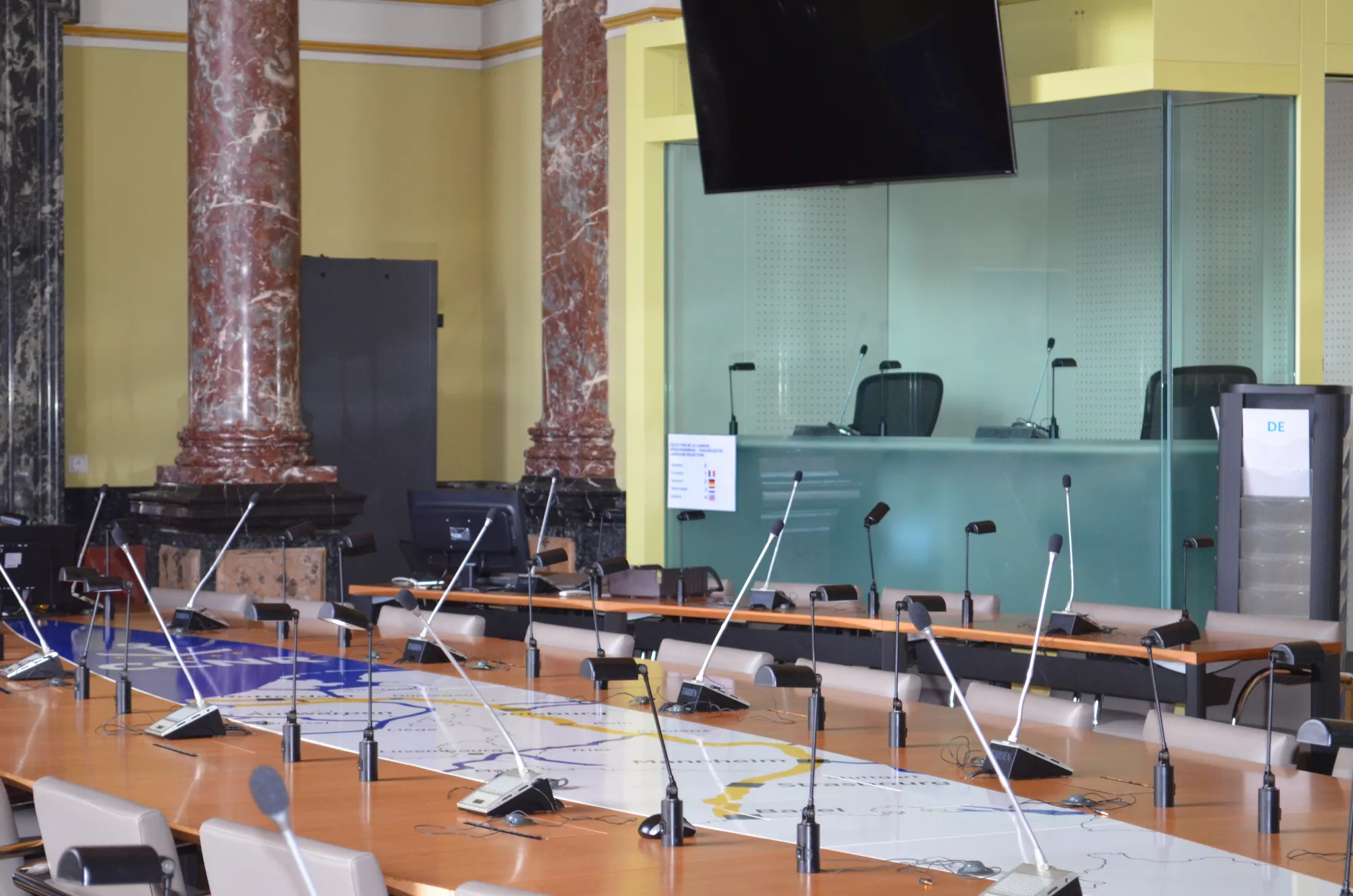
The Chamber of Appeal sits as required, usually at least twice a year. Its working languages are French, German, English and Dutch. As a rule, decisions are taken after an oral hearing. Parties who are summoned are not obliged to attend the hearing. They may defend their rights themselves or be represented by a lawyer admitted to plead before a court in a Member State or by any other person with a written power of attorney. In civil matters, the parties must, except for the taking of evidence, be represented by a lawyer admitted to plead before a court of a contracting Member State if they were already subject to this obligation at first instance.
The Presiding Judge of the Chamber of Appeal directs the proceedings and takes the necessary steps to prepare decisions. The Chamber deliberates and reaches its decision in closed session. It decides on the merits (which means that it can make its own findings on the facts and the law) or refers the case back to the court that decided in the first instance for reconsideration. The judgment is drawn up in the language used at the court that deliberated in the first instance. It becomes final on being made public and is notified to the parties through the court of first instance. The Registrar also sends the parties a copy of the judgment.
No charge is made in respect of proceedings brought before the Chamber of Appeal.
Basic documents
Revised convention for Rhine navigation
- Articles 33 to 40
- Articles 45bis and 45ter
Rules of procedure of the Chamber of Appeal
Case-law and precedent
Important decisions
524 Z (23 Februar 2021)
- Éléments essentiels concernant la décision 524 Z
473 Z - Havarie TMS Waldhof (18 March 2013)
- Éléments essentiels concernant la décision “Waldhof”
- Press release regarding the “Waldhof” decision
All decisions
The Chamber of Appeal of the CCNR publishes all its decisions through the iwt-law.eu database.
The iwt-law.eu database is a free digital compilation of national and international decisions in the field of inland waterway transport law. This database of the Institute for German and International Transport Law of the University of Mannheim provides an efficient and simple way of searching for case law, based on criteria such as the case number, the type of decision, the standards contained, the type of court and its location. The wealth of case law currently contains around 1,800 rulings in the field of inland waterway transport law. The iwt-law.eu database supports the work of lawyers and judges as well as scientific research in the field of inland waterway transport law.
Articles
- Jurisprudence 2015 - 2021 de la Chambre des appels auprès de la Commission centrale pour la Navigation du Rhin en matières pénales et les amendes
publié dans LAMY, Le Droit Maritime Français (DMF) Nº876 - Février - 2025 - Rechtspraak 2015-2021 van de Kamer van Beroep bij de Centrale Commissie voor de Rijnvaart inzake straf- en geldboetezaken,
gepubliceerd in het Tijdschrift voor Internationale Handel en Transport (IHT, 2024, 2, p. 3-19) - Rechtsprechung 2014-2021 der Berufungskammer der Zentralkommission für die Rheinschifffahrt in Straf- und Bussgeldsachen,
veröffentlicht in European Transport Law, 3.2024, p. 269-284 - Jurisprudence 2014 – 2021 de la Chambre des appels auprès de la Commission centrale pour la navigation du Rhin en matière d’accidents de la navigation et d’abordages [Première partie]
publié dans LAMY, Le Droit Maritime Français (DMF) Nº 855 - Mars - 2023 - Jurisprudence 2014 – 2021 de la Chambre des appels auprès de la Commission centrale pour la navigation du Rhin en matière d’accidents de la navigation et d’abordages [Suite et fin]
publié dans LAMY, Le Droit Maritime Français (DMF) Nº 856 - Avril - 2023 - Rechtsprechung 2014 - 2021 der Berufungskammer der Zentralkommission für die Rheinschifffahrt über Schiffsunfälle und Kollisionen
Literature on the Chamber of Appeal
- W.E. Haak, "Experience in the Netherlands Regarding the Case-Law of the Chamber of Appeal of the Central Commission for the Navigation of the Rhine",
Netherlands Yearbook of International Law, 1988, pp. 1-51 - Karl-Heinz Bauer, "Die Berufungskammer der Zentralkommission für die Rheinschifffahrt in Strassburg",
Festschrift für Günther Wiese, 1998, pp. 1-9 - Adrian Staehelin, "Mannheimer Akte und Europäische Menschenrechtskonvention",
Europeanisering van het Nederlands recht, 2004, pp. 103-114 - Dr. Marc De Decker, "Europees internationaal rivierenrecht"
- Mr. W.E. Haak en Jhr. Mr. B.C. de Savornin Lohman, "Procederen in Rijnvaartzaken"
Further reading
Documentation