Introduction
The protection of the environment has a special significance for a mode of transport that, at least partly, uses a natural infrastructure. Major rivers form the backbone of a network of waterways that also includes estuaries, lakes and canals. The sustainable use of this largely natural infrastructure places high demands on its users.
The general considerations that apply to inland navigation of course also apply to navigation on the Rhine. Even though the Mannheim Act of 1868 contains no specific mention of protecting the natural environment of the Rhine, this has long been an important area for the Central commission for the Navigation of the Rhine (CCNR). Since the start of the 20th century, the CCNR has interpreted “general safety” as including the prevention of pollution and the protection of the environment (resolution 1996-I-14
 , resolution 1996-I-15).
In concrete terms, these efforts to protect the environment take the form of a permanent fight against all forms of pollution.
To this end, the CCNR Regulations include provisions intended to prevent pollution as a result of Rhine navigation. For example, certain provisions contained in the Police Regulations (notably Chapter 15), the Regulation on the carriage of dangerous goods and the Rhine Vessel Inspection Regulations. In addition, the CCNR supported the publication of the ISGINTT (International Safety Guide for Inland Navigation Tank-barges and Terminals) guide on the ship-shore interface, which is also aimed at avoiding accidental pollution.
The various fields of action distinguish between, on the one hand, protection against pollution caused by accidents (”accidental pollution”) and, on the other hand, protection in terms of operating practices on board vessels, the techniques used and the treatment of the resulting waste (“operational protection”).
Protection against pollution caused by accidents
In inland navigation, accidents may occur as a result of technical faults or human error, just like in any human activity.
Such risks are a major consideration when drafting safety guidelines. A thorough analysis of the various situations that may arise, as well as of accidents that have occurred in the past, forms one of the foundations of regulatory work.
This analysis enables the implementation of a coherent set of measures aimed at achieving a high level of passive safety (i.e. without human intervention) for inland waterway transport. It also aims to limit pollution in the event of accidents.
Further information is available on the pages relating to “Technical requirements for vessels” and “Transport of dangerous goods”.
Protection against pollution caused by vessel operation
Reduction of greenhouse gas emissions and air pollution
Inland navigation uses almost exclusively diesel engines and diesel fuel for propulsion. The emission of exhaust gases containing harmful compounds is thus unavoidable. The CCNR has introduced regulations aimed at controlling these compounds.
Engines newly installed on inland navigation vessels must be type-approved to CCNR I from 2003, CCNR II from 2007 or Stage V from 2020/2021.
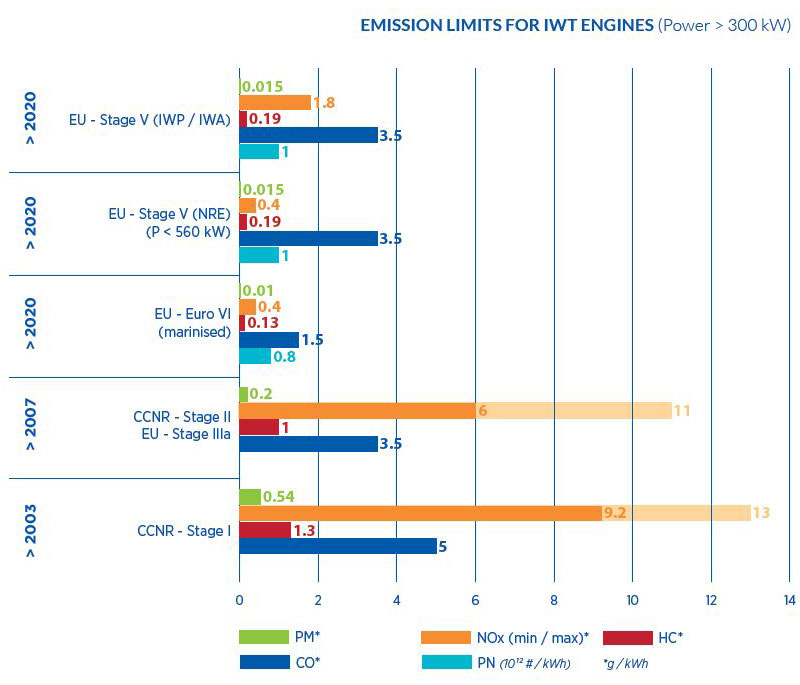
Source CCNR roadmap for the reduction of inland navigation emissions
CO: Carbon monoxide
HC: Total hydrocarbons
Nox: Nitrogen oxides
PM /PN: Particulate matter/Particle number
Furthermore, in 2021 the CCNR also adopted a roadmap for reducing greenhouse gas emissions and air pollutants. Further information on this subject is available on the ‘Energy Transition’, ‘Study on the energy transition’ and ‘Roadmap for reducing inland navigation emissions’ pages.
Management of waste produced on board vessels (CDNI)
As with any other human activity, the transport of passengers or goods will generate waste.
In recognition of the environmental issues at stake for inland navigation, six States decided to establish international regulations for the collection, deposit and reception of waste produced during navigation.
Based on the work of the CCNR, the Convention on the collection, deposit and reception of waste produced during navigation on the Rhine and inland waterways (CDNI) entered into force on 1 November 2009. The CDNI has been adopted by six States: Belgium, France, Germany, Luxembourg, the Netherlands and Switzerland.
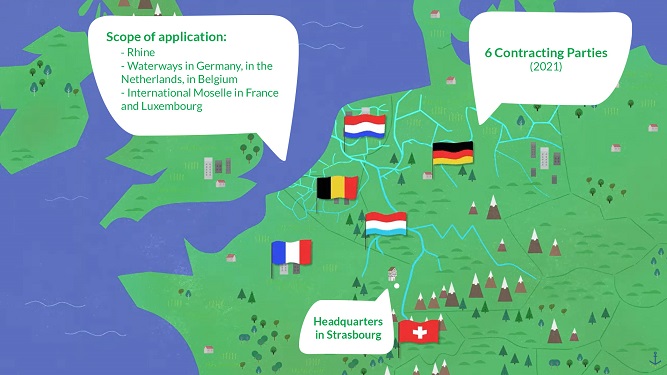
The CDNI imposes a general ban on the dumping and discharge of waste generated on board (oily and greasy waste, parts of the cargo, other waste such as waste water). Since 1 October 2024, the CDNI also includes a progressive prohibition to ensure that gaseous cargo residues (vapours) which are harmful to the environment are no longer released into the atmosphere. Exceptions to this prohibition are strictly defined.
The CDNI:
- promotes waste prevention,
- channels waste to reception facilities located throughout the waterway network,
- ensures adequate funding in accordance with the ‘polluter pays’ principle,
- facilitates the monitoring of compliance with bans on the dumping and discharge of the waste concerned into surface water.
The CDNI has its own monitoring structure, comprising a Conference of Contracting Parties (CPC) and an International Clearance and Coordination Body (IIPC). The CPC is assisted in its work by a Working group (CDNI/G). The executive Secretariat for these bodies is supplied by the Secretariat of the CCNR from its headquarters in the Palais du Rhin in Strasbourg.
Further information about the CDNI is available on its website: https://www.cdni-iwt.org/
Natura 2000 zones on the Rhine
Information on the NATURA 2000 zones located along the Rhine is available on the website of the International Commission for the Protection of the Rhine (ICPR): https://www.iksr.org/en/topics/uses/nature-protection
Further reading
Documentation
Police regulations for the navigation of the Rhine