Introduction
Providing and maintaining the Rhine infrastructure are the responsibility of the riparian States, as is the organisation of any work needed.
The role of the Central commission for the Navigation of the Rhine (CCNR) is primarily to monitor these measures at international level. It ensures that they are coordinated and verifies that they are appropriate to the needs of navigation. Information on infrastructure projects planned by States (e.g. the construction of new bridges) is submitted to the CCNR for advice or authorisation, as appropriate. In addition, general policies on infrastructure improvement and all related matters are discussed within the Central Commission with a view to establishing common guidelines or requirements.
- Article 28 of the Revised Convention for Rhine Navigation (“Mannheim Act


 ”) states that the Contracting States undertake to maintain the navigable waterway of the Rhine and the towpaths. Where necessary, the States will mark the fairway using buoys. The cost of maintaining the fairway shall be borne by each State for its part of the river. Where the river acts as a border, each State shall bear half the cost.
- Article 29 lays down that States will exchange information through the CCNR on hydraulic projects which may have a direct or indirect effect on navigation. It also states that States should carry out such work in the manner most acceptable to all parties. Any questions arising from such work shall also be discussed within the CCNR.
- Article 30 of the Mannheim Act lays down that Member States shall ensure that navigation on the Rhine is not hindered by any structures such as bridges or factories.
- Article 31 states that national governments shall carry out regular surveys of the river to observe the results of measures taken for its improvement and to note any obstacles. Findings will be reported to the CCNR.
Procedures and minimum requirements for structures on the Rhine
The CCNR bodies concerned with matters relating to infrastructure and the environment examine the communications from delegations relating to measures taken to improves conditions for navigation on the Rhine. These bodies are responsible for checking construction work that may affect inland navigation, in accordance with the “Procedures for establishing conditions and requirements for structures on the Rhine within the CCNR framework”:.
In addition, the CCNR has agreed minimum requirements as well as recommendations for the technical design of structures on the Rhine. These serve as a basis for assessing construction projects and as criteria for the CCNR’s decisions regarding the authorisation of structures on the Rhine. The document “Minimum requirements and recommendations for the technical design of structures on the Rhine” is available at:.
Finally, in addition to the CCNR, specific agreements and arrangements apply to canalisation works on the Upper Rhine.
Closure of certain lock basins on the upper Rhine
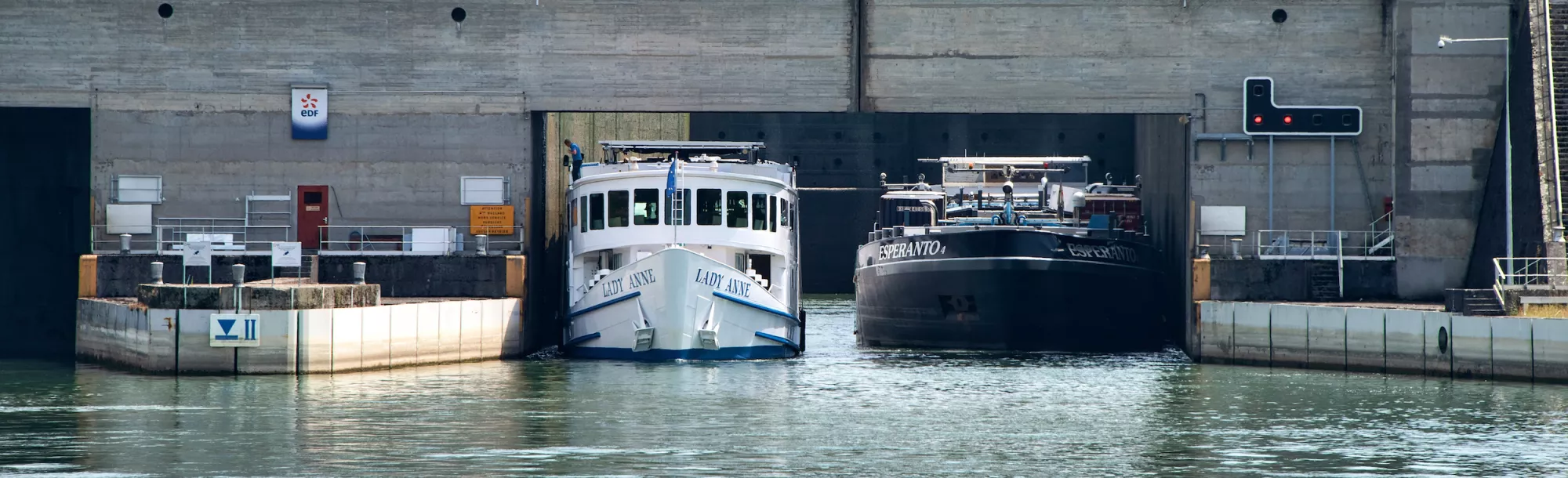
On the international section of the Upper Rhine there are 10 locks, each of which has two basins. These were built between 1932 and 1977 and are currently undergoing significant maintenance work. In order to avoid disrupting navigation, work is not carried out on the two basins simultaneously, thus one basin is always available to shipping. The closure dates for the various lock basins on the Upper Rhine are laid down each year in a CCNR resolution.
Table showing closures on the Rhine and the Grand Canal d’Alsace