Introduction
With regard to low water levels, the Central Commission for the Navigation of the Rhine (CCNR) acts primarily as a platform for exchange and information. Together with its partners, the CCNR has been monitoring and studying the effects of low water levels for many years, and more intensively since the extreme low water levels of 2018. Key activities have included the organisation of workshops in 2019 and 2023 and the publication of several editions of the discussion paper “Act now!”


 . Since 1933, the CCNR has set the equivalent water level (EWL). The consequences of low water levels on freight transport are also monitored in the CCNR's annual market observation reports.
Although periods of low water levels are neither new nor even exceptional, the vulnerability of inland waterway transport to periods of low or even extremely low levels has increased in recent decades. This situation is the result of a number of factors, both internal and external to inland navigation. It is therefore likely that climate change will also present new challenges for Rhine navigation. Extended periods without rainfall, leading to drought, can have a negative impact on transport capacity and, in the long term, may influence the mode of transport chosen by shippers. In addition, over the last few decades, the Rhine fleet and the requirements imposed on inland waterway transport have undergone considerable changes. Both the vessels and their laden draughts have increased significantly. At the same time, the integration into the logistics chains of the industry, the ‘just in time’ principle and stricter requirements in terms of reliability pose major challenges for river transport.
However, the inland navigation sector plays a key role in meeting the ambitious goals of a modal shift and reduced emissions set at international level, notably in the CCNR Mannheim Declaration and the EU Green deal. Inland waterway transport will therefore continue to be indispensable, especially for transporting large quantities of goods for which there are no alternatives, as well as heavy and bulky cargos. To reduce emissions and meet the needs of the sector, it is essential to ensure that inland waterway transport remains an efficient and reliable mode of transport. The resilience of inland waterway transport to low water events must therefore be improved in the short, medium and long term.
Low water levels and the impact on inland navigation
The low water event in the Rhine that occurred in 2028 was not unprecedented. During the last 200 years, there have been 14 years with low water levels on the Rhine (see Figure 1), during which navigation would have been hindered for a comparable number of days if the current infrastructure requirements had been applied. The majority of these low water events took place before 1972.
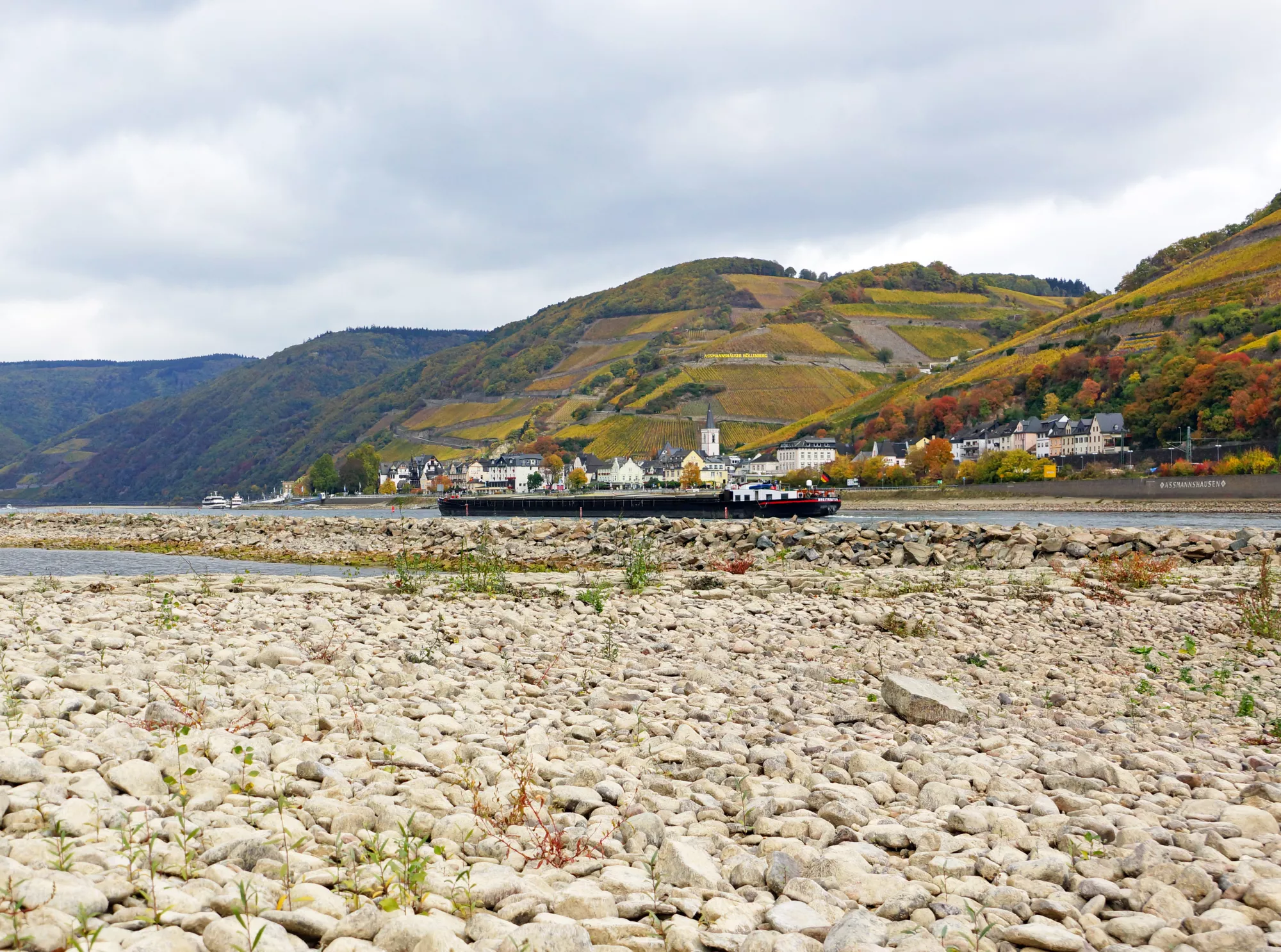
In general, low water levels have a negative impact on the volume of cargo transported on inland waterways. This is due to the reduction in a vessel's permissible laden draught when there is less water under the keel.
As inland waterway transport is an important mode of transport for the carriage of goods (such as iron ore, coal, chemicals, agricultural products and containers), a reduction in the permissible laden draught of a vessel leads to a considerable reduction in the volumes that can be transported. This is because raw materials such as iron ore require a sufficient water depth to be transported in large quantities.
In some cases, particularly if the low water levels persist for several weeks and the available water level dips below the critical threshold, the resulting reduction in the volume of goods transported also affects industrial production. As well as the effect this has on imports and incoming traffic (from the point of view of industry), industrial production may also slow down because of the drop in the number of finished products that can be transported during periods of low water levels. This applies particularly to the chemical industry in the Rhine basin, whose logistics are heavily dependent on the Rhine and inland waterways in general.
Low water levels result in higher costs for inland waterway transport, due to increased fuel consumption per tonne of goods transported, in order to cover fixed transport costs and to compensate for the decline in the volume of goods transported. The rise in fixed transport costs leads to an increase in transport prices (freight rates). If the low water period lasts for several months, this increase in fixed transport costs and freight rates is then passed on to the price of finished products. Another significant effect is the increase in fuel prices at bunkering stations, if the increase in freight rates is also applied by tankers. The transport prices or freight rates also increase because the overall transport capacity (the total available capacity of the fleet) is limited during periods of low water. This reduction in capacity leads to a change in the relationship between supply and demand in the market.
Low water events affect the logistic chains, particularly with regard to managing unexpected stockpiles in maritime and inland ports, with goods being stored for longer than planned. They also cause delays in loading and unloading activities, which affect not only river transport but also other modes of transport.
Extreme low water levels over a long period can result in the temporary transfer of some freight transport to other modes of transport, particularly rail and road, especially for market segments where there is strong multimodal competition, such as container transport. With regard to bulk goods, it should be noted that other modes of transport are not able to replace inland waterway transport in the short term. However, it is possible that periods of low water levels could result in market losses in the longer term.
Recent low water events
2018
The period of low water levels in 2018 was not the longest period recorded on the Rhine during the last 100 years. While it was one of the most severe low water events recorded since 1900, there were four other years in which the periods of low water levels were significantly worse (see Figure 1). However, 2018 was the year in which river transport suffered the greatest economic consequences as a result of low water. Two different econometric models have shown that this period of low water levels (autumn 2018) had a significant negative effect on German industrial production during 2018.
This very severe impact is due to a number of factors, such as:
- Changes to the fleet: inland navigation vessels have got progressively larger in recent decades, however large vessels are more vulnerable to low water levels. This raises the question of new/updated logistic concepts and vessels with a shallower laden draught, including a possible return to smaller vessels in the future.
- Infrastructure and logistics: currently the preferred system is based on ‘just-in-time’ logistics, whereby raw materials, products and parts are received as they are needed, rather than having them in stock. This allows businesses to cut storage costs by not having to store as much material. However, this strategy can cause problems when water levels are low.
It is important to stress that, while the Rhine was severely affected in 2018, river transport never completely stopped.
2022
Due to a number of macroeconomic factors, the situation in 2018 cannot be extrapolated to 2022. They include high energy prices, the war in Ukraine, a shortage of vessels (transporting grain in Solidarity Lanes), the post-COVID effects, etc. The combination of all these factors led to a complex situation.
Furthermore, the low water period in 2022 began during the second half of July, which is earlier than for low water periods in the past. Although there were far fewer low water days in 2022 (41 days) than in 2018 (107) the negative economic effect was still significant. It should be noted that in August 2022 there was still uncertainty about the evolution of the low water period and its consequences. The reduction in the loading rate of vessels due to low water levels resulted in a decrease in the volume of goods transported per trip and an overall reduction in transport services.
In order to compensate for this loss of transport capacity, inland navigation companies increased freight rates, which led to higher transport costs. Freight rates on the spot market saw the same increase as in 2018. For example, for the transport of liquid cargos between the ARA region (Amsterdam - Rotterdam - Antwerp) and the Rhine hinterland, freight rates on the spot market were around four times higher than normal.
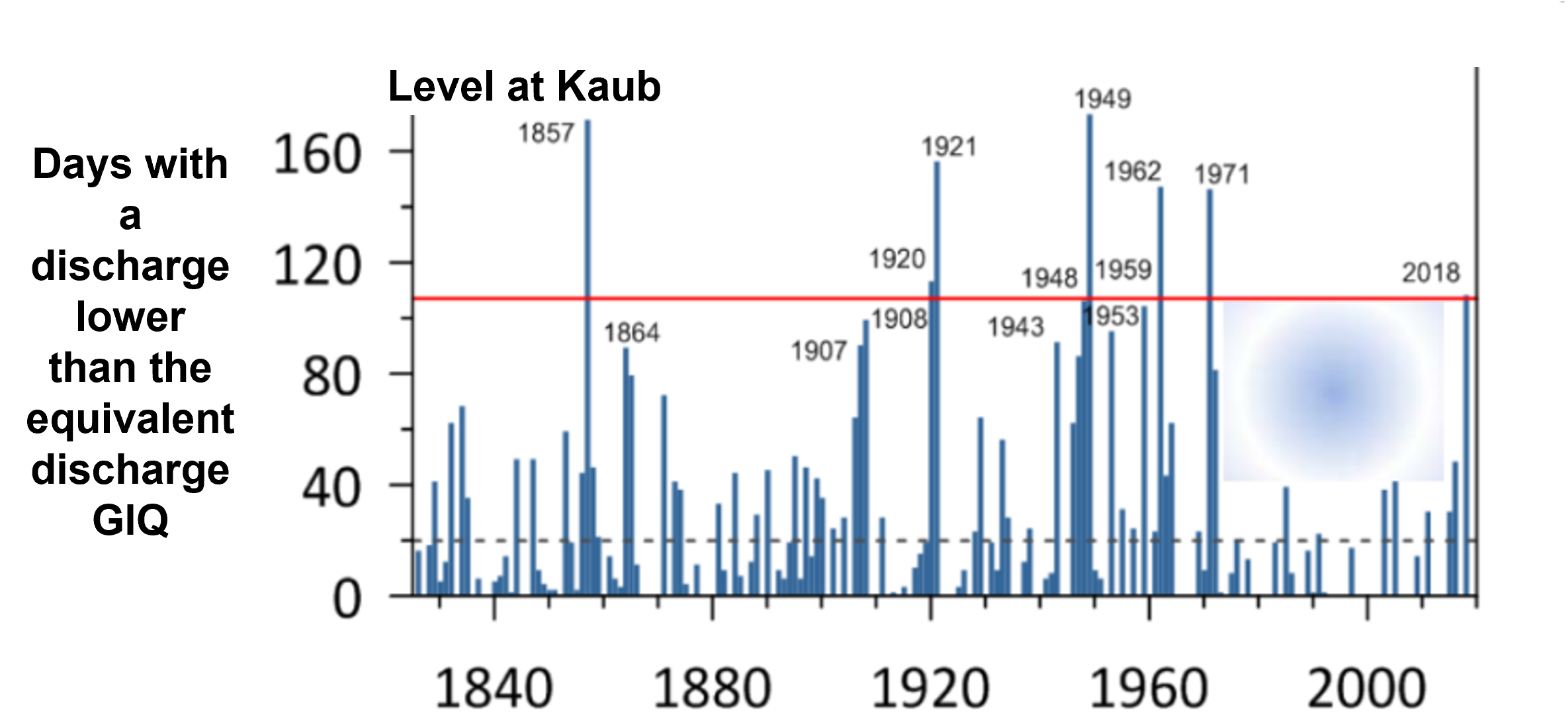
Figure 1: Number of days with a discharge lower than the equivalent discharge GlQ
Source : WSV
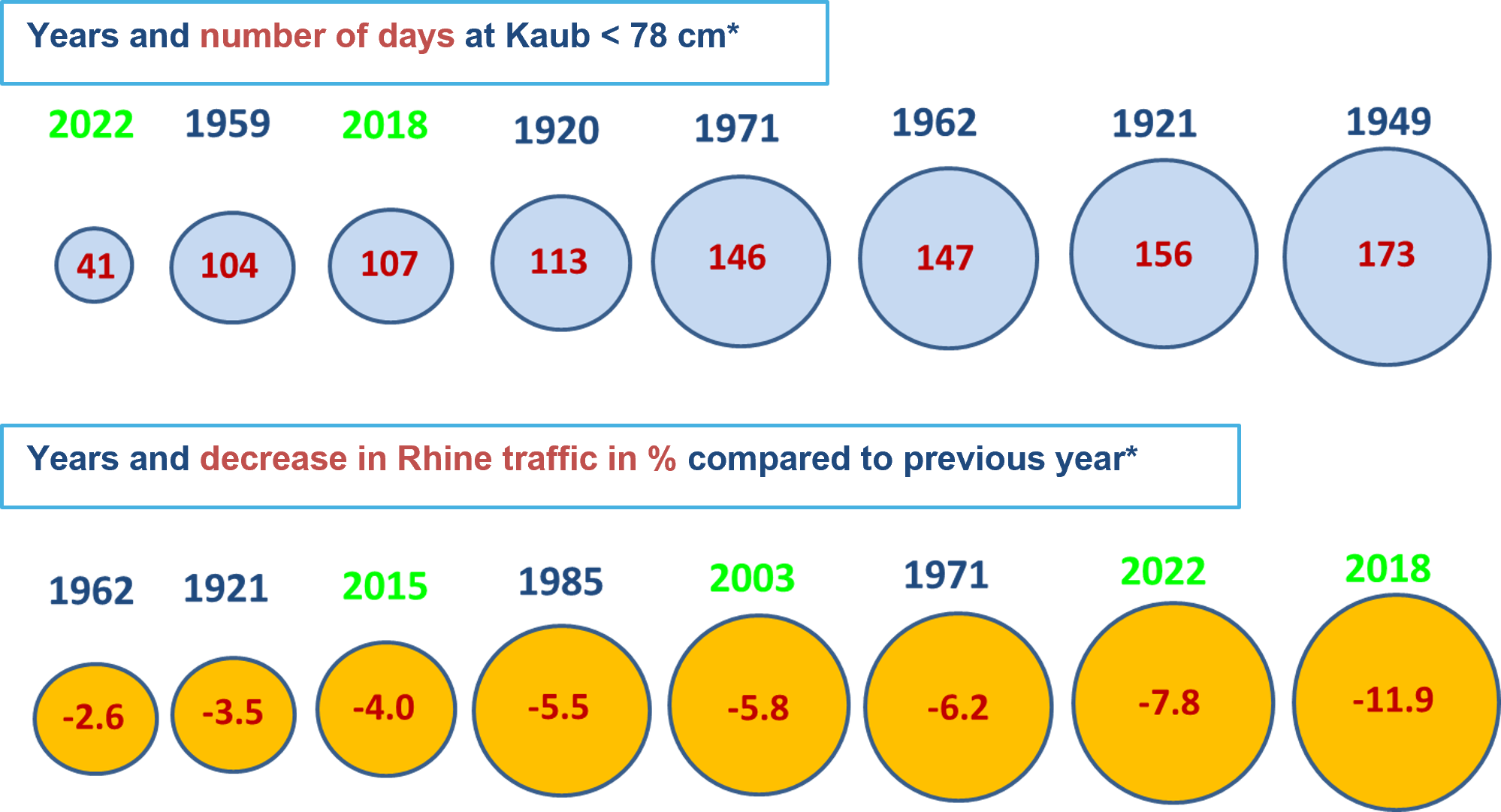
Figure 2: Number of low-water days (Discharge ≤ than the current GIQ) during years with low water periods versus the impact on Rhine traffic
Source: “Act now!”, 2023, based on the EWL 2012-2022. CCNR calculation based on data from Destatis and the German Federal Waterways and Shipping Administration (Wasserstraßen- und Schifffahrtsverwaltung – WSV), and provided to them by the Federal Institute of Hydrology (Bundesanstalt für Gewässerkunde – BfG). In the context of this figure, it should be noted that while the year 2022 is far from being the eighth longest low water event of the last 100 years, as it ranked second in the low water years with the most severe economic impact on river transport on the Rhine, it was decided to include 2022 in the first line of this figure.
* The World War years (1914-1918 and 1940-1945) and the years marked by economic depression (1919, 1923, 1931, 1932, 1975, 2009) are excluded. In 2022, the decrease in Rhine traffic is also linked to the consequences of the war in Ukraine.
Reflection paper “Act now!”
In November 2019, the CCNR organised a workshop on low water levels and their impact on Rhine navigation. This workshop led to the publication of the first edition of the “Act now!” reflection paper, which covered the impact of low water levels on the fleet, infrastructure, the environment, shippers and logistics, together with possible solutions to the problem. As the CCNR emphasised in the 2019 reflection paper “Act now!”, there is no universal solution to the challenges caused by periods of low water. A combination of measures will be needed to adapt the fleet, infrastructure, and logistics and storage concepts, as well as to implement digital tools. Just as there is no single central instrument, there is also no single actor capable of solving all the problems on its own.
A second edition of the reflection paper was published in 2021. It included an inventory of relevant projects contributing to addressing low water challenges.
On 18 January 2023, the CCNR organised a follow-up expert workshop around the topic “Low water and its effects on Rhine navigation”. Later that same year, in October 2023, the CCNR published the third edition of the reflection paper “Act now!”. This edition incorporated the results of the 2019 workshop on low water levels and of the follow-up expert workshop in 2023. The main updates relate to the analysis of the low water event in 2022 and the latest developments in the areas of infrastructure, vessel adaptation and digital tools, as well as in aspects related to shippers and logistics.
The third edition of the reflection paper “Act now!” is available at, together with all the information relating to the workshops on low water levels organised by the CCNR.
One of the main conclusions that emerged from the workshops was the need to intensify the dialogue among all the relevant stakeholders. The CCNR encourages and supports such a dialogue.
The CCNR also reports regularly on the economic impact of periods of low water in its market observation reports. These are available at https://inland-navigation-market.org/.
Useful links
As part of the COMEX project, co-funded by the EU, 13 States have developed the EuRIS portal. This provides river transport operators with a wealth of coordinated information on infrastructure, current traffic and traffic forecasts, for example at locks. It also enables vessel owners to share their own information with their customers and clients in order to improve river transport logistics.
EuRIS provides the most recent water levels for the whole of the European interconnect ednavigable waterways network, in the form of a map or tables. The information is available in all the languages of the 13 participating States.
- Information on the EuRIS and the water levels measured at the gauges: https://www.eurisportal.eu/hydrometeo/kaart?KL=en.
- The German Federal Waterways and Shipping Administration publishes the water levels recorded by the gauges on its Elwis website: https://www.elwis.de/DE/Service/Wasserstaende/Wasserstaende-node.html This site also provides long-term forecasts and projections for selected gauges, such as Kaub, Duisburg and Emmerich. These details enable all river transport stakeholders to anticipate changes in water levels and adapt their activities according to the depth available in the fairway. This information is only available in German.
- The Federal Institute of Hydrology (Bundesanstalt für Gewässerkunde - BfG) provides regular updates on the meteorological and hydrological situation for German inland waterways during periods of low water levels: https://www.bafg.de/DE/5_Informiert/2_Publikationen/Niedrigwasserbericht/niedrigwasserbericht_node.html
- The International Commission for the Protection of the Rhine (ICPR) monitors periods with low water levels as part of its low flow monitoring: https://undine.bafg.de/rhein/zustand-aktuell/rhein_nw_mon_en.html
- Communication BfG 35: the low water sequence from 2015 to 2018 in Germany – analysis, classification and repercussions. See: https://www.bafg.de/SharedDocs/Downloads/DE/bfg_mitteilungen/BfG-Mitteilungen35.html
- The Rijkswaterstaat website (www.vaarweginformatie.nl) provides current water levels for the most important European waterways, in both Dutch and English:
The Swiss national drought platform (www.trockenheit.ch or www.trockenheit.admin.ch) is the result of a joint initiative by the Federal Office for the Environment, the Federal Office of Meteorology and Climatology and the Federal Office of Topography, intended to provide a drought monitoring and warning system. The platform is not solely a forecasting tool, it also provides data going back to 1991. It also allows users to view water level notices and forecasts, which are updated daily, as well as data on the flow rates of Switzerland's main rivers and lakes. A data interface is also available for institutional users.