
The paragraphs below provide a summary of this very complex legal framework.
Geographical scope
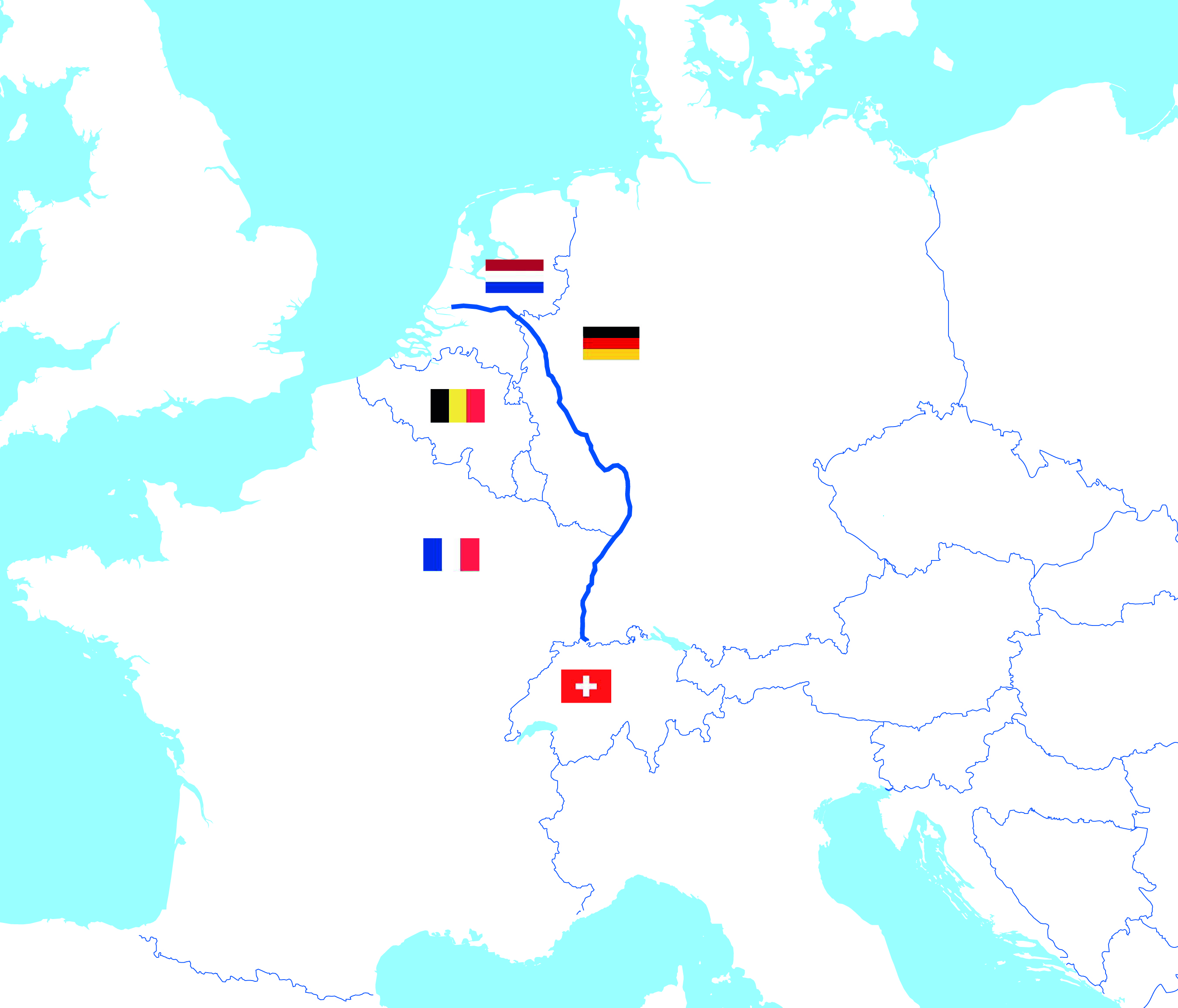
The Mannheim Act is a complex agreement whose provisions do not all follow the same rules of application, particularly with regard to their geographical scope. The general indications that follow do not cover all the modalities of its application.
Upstream, the scope of the Mannheim Act begins at the point where "natural navigation" starts (Annex 16 B Vienna Final Act, Article 1). According to the Swiss authorities, this point is located at the central bridge upstream of the Port of Basel (km 166.64) (Mittlere Rheinbrücke).
Downstream, the international regime extends to the open sea on all routes leading from the Rhine to the sea or to Belgium (Mannheim Act, Article 2) used by commercial shipping. Between Krimpen aan de Lek and Gorinchem (Netherlands) and the open sea, certain special rules apply.
The entire width of the river is subject to international regulations, including the banks and towpaths, the waters of the ports and, to a certain extent, the quays, loading and unloading areas and warehouses (Mannheim Act, Articles 8, 27 to 31).
The tributaries of the Rhine are partly covered by the provisions of the Mannheim Act relating to freedom of navigation (Articles 3 and 4), subject to special stipulations (such as the Convention relating to the canalisation of the Moselle, of 27 October 1956). For the Main, its status as a tributary applies up to kilometre 387.69 (Hallstadt railway bridge), though specific rules also apply..
Material scope
The Mannheim Act comprises a set of rules that can be summarised as the "Rhine regime", which cover various aspects of navigation.
Principle of freedom of navigation
Navigation on the Rhine is free and open, subject to compliance with the regulations adopted to maintain general safety.
This regime applies to commercial shipping. Specific rules apply to pleasure, sports and military craft. Transport from one bank to the other is also excluded from the regime (Mannheim Act, Article 24).
Navigation is open to vessels of all nations, but with certain restrictions, as set out in Additional Protocol No. 2 of 1979. These restrictions apply to vessels that do not fly the flag of one of the signatory States of the Mannheim Act or of a Member State of the European Union. For those States, transit traffic is free, exchange traffic is subject to agreements with the States concerned and Rhine cabotage traffic is governed by conditions determined by the Central Commission for the Navigation of the Rhine (CCNR).
There are no restrictions on Rhine cabotage traffic (between two ports on the Rhine) for vessels with a Rhine navigation certificate. To obtain such a certificate, there must be a real link between the vessel and the State concerned (signatory State of the Mannheim Act or Member State of the European Union), as specified in the Application Regulation of the CCNR (Resolution 1984-I-3) 
 and the Council Regulation No 2919/85 of 17 October 1985.
Principle of a single regime
In order to allow free movement, the rules concerning navigation on the Rhine are governed by uniform regulations which apply to the whole river (although there may be special provisions covering certain sectors). These common regulations are laid down by the Central Commission.
To ensure the unity of the regime, safety issues specific to navigation on the Rhine are regulated solely by the CCNR. Member States may not adopt provisions at national level which impose a restriction on navigation on the Rhine unless they are of a general nature not specific to navigation or unless the CCNR has expressly recognised the competence of the Member States (Mannheim Act, Article 23).
Principle of equal treatment
All those involved in navigation on the Rhine must be treated equally, regardless of nationality.
Consequently, differences in treatment (for example, based on the technical characteristics of vessels) must be justified by objective factors relating to general safety, orderly traffic or the general interest. (See the decision of the Appeals Chamber of 10 February 2003: 415 P – 1/03 H).
Principle of maintaining and improving the navigable waterway
The Mannheim Act lays down the principle of conserving, maintaining and improving the Rhine navigable waterway (Mannheim Act, Articles 27 to 31).
The work required is carried out by the riparian States. However, the Central Commission monitors and consults on the measures to be taken: it examines any projects that may affect navigation, such as bridges or changes to the navigable fairway.
The Treaty of Versailles (Article 358) also conferred special rights on the CCNR for the Franco-German stretch of the Rhine. For this section, all planned works are communicated to the Central Commission, which ensures that they will not hinder navigability or reduce navigation facilities.
Absence of navigation fees
Pursuant to Article 3 of the Mannheim Act, Member States shall refrain from imposing on Rhine navigation any toll, tax, duty or charge based directly on the fact of navigation.
This rule does not prevent the imposition of charges for services rendered or taxes based on a different assessment, such as value added tax (VAT).
To supplement this provision, a supplementary agreement to the Mannheim Act was adopted on 16 May 1952 concerning the customs and tax regime for diesel consumed as bunkering on board vessels on the Rhine. This agreement stipulates that the CCNR States will not levy customs duties or other taxes on diesel consumed as bunkering for vessels on the Rhine.
A number of provisions of the Mannheim Act relate to customs matters. They have now lost much of their relevance.
Regulation of Rhine navigation
The Revised Convention for Rhine Navigation or Mannheim Act combines freedom and order. To guarantee the safety of navigation on the Rhine, the CCNR issues regulations. These concern:
- vessel technical requirements (Rhine vessel inspection regulations);
- rules concerning inland navigation personnel (Regulations for Rhine navigation personnel;
- regulations concerning traffic (Police regulations for the navigation of the Rhine);
- regulations concerning the transport of dangerous goods (ADN Regulations).
Further reading



Documentation
Additional Protocol No. 1 to the Revised Convention for Rhine Navigation
Additional Protocol No. 2 to the Revised Convention for Rhine Navigation

Additional Protocol No. 3 to the Revised Convention for Rhine Navigation

Additional Protocol No. 4 to the Revised Convention for Rhine Navigation
Additional Protocol No. 5 to the Revised Convention for Rhine Navigation
Additional Protocol No. 6 to the Revised Convention for Rhine Navigation
Common interpretation of Additional Protocol No. 6 to the Revised Convention for Rhine Navigation