
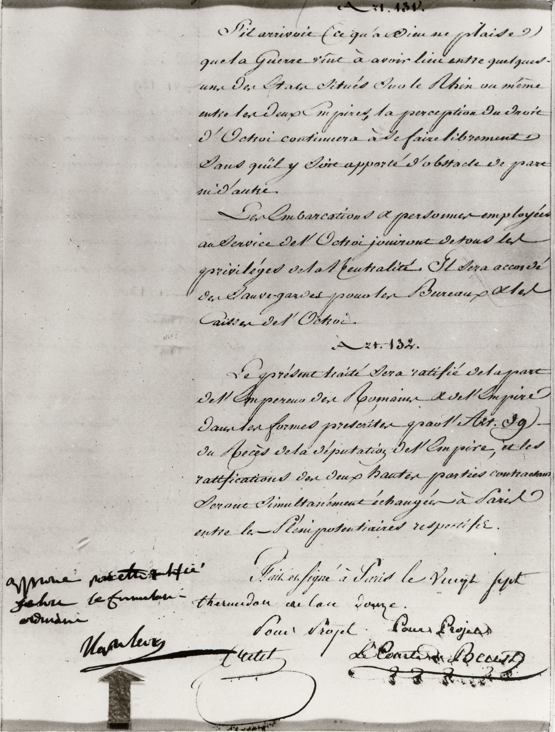
The international legal status of the Rhine as a navigable waterway dates back to 1804. The Rhine Octroi Treaty of 15 August 1804, concluded between The French Empire and the German Holy Roman Empire, established a unique toll system, managed by a central international administration.
This institution evolved, in a modified legal form, to become the Central Commission for the Navigation of the Rhine (CCNR). The CCNR was formally created by Annex 16B to the Final Act of the Congress of Vienna, signed on 24 March 1815 and known as the “Rhine Regulation”. The Central Commission provided the framework for a supplementary convention, the Mainz Convention, signed on 31 March 1831.
This convention was followed by the revised Convention for the navigation of the Rhine, of 17 October 1868 (the Mannheim Act), which still forms the legal foundation of the CCNR. The current version of this Convention is the outcome of the Convention of 20 November 1963


 (entered into force on 14 April 1967), which itself has been further amended to include 7 Additional Protocols (not all of which have yet entered into force).
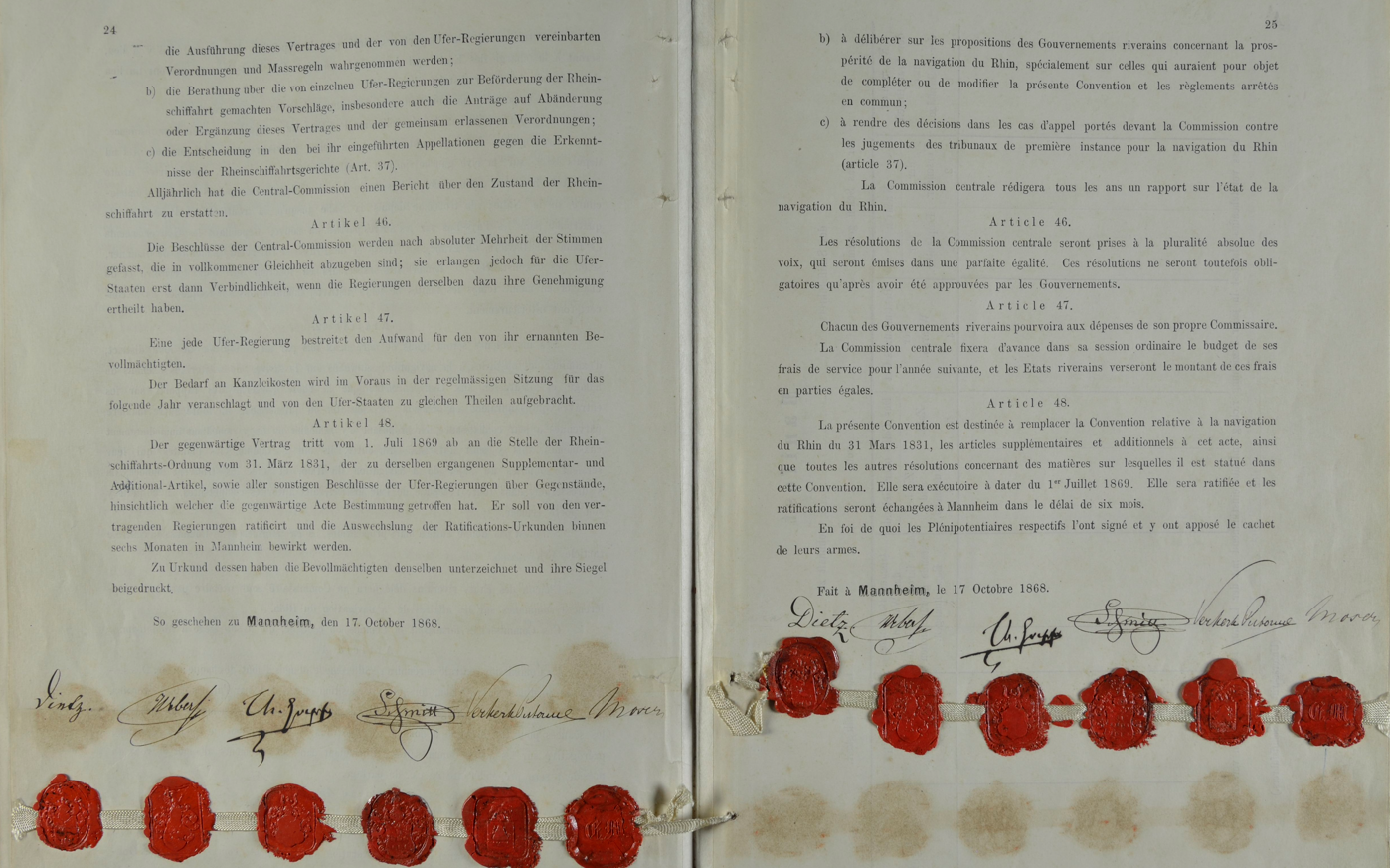
The Mannheim Act defines the legal status of the Rhine as an inland waterway for navigation and sets out the remit of the Central Commission. This Convention is considered to be a “living instrument”, with the interpretation and implementation evolving in line with changing needs. A 2003 resolution (2003-II-10) lays down the principles for the interpretation of the Mannheim Act.
Further reading



Documentation
Additional Protocol No. 1 to the Revised Convention for Rhine Navigation
Additional Protocol No. 2 to the Revised Convention for Rhine Navigation

Additional Protocol No. 3 to the Revised Convention for Rhine Navigation

Additional Protocol No. 4 to the Revised Convention for Rhine Navigation
Additional Protocol No. 5 to the Revised Convention for Rhine Navigation
Additional Protocol No. 6 to the Revised Convention for Rhine Navigation
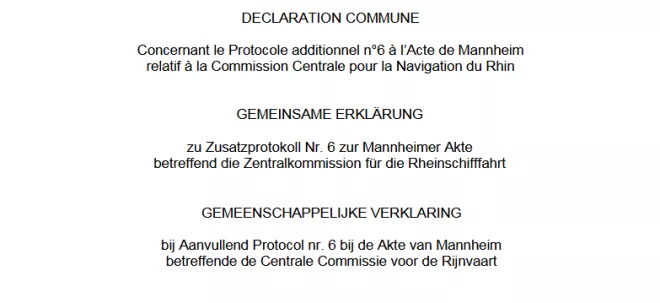
Common interpretation of Additional Protocol No. 6 to the Revised Convention for Rhine Navigation