
The following paragraphs describe the evolution of the Central Commission for the Navigation of the Rhine (CCNR) throughout its history.
1804-1814
In the period leading up to the formal constitution of the Central Commission in 1815, two essential measures were instituted and were subsequently adopted by the Commission:
- the creation of an international river organisation,
- the establishment of the principle of freedom of navigation.
The Rhine Octroi Treaty, governing the levying of tolls on the Rhine, was concluded on 15 August 1804 between The French Empire and the German Holy Roman Empire, thereby implementing a directive issued by the Imperial Deputation on 25 February 1803. The Treaty abolished the various tolls previously existing on the Rhine in favour of the institution of a “Rhine Octroi”, and established in Mainz the first international administration responsible for centralising the octroi levied on Rhine shipping. These payments were used in particular to improve navigability and towpaths. This administration also had a role in settling disputes arising from the imposition of the levies.
The Treaty of Paris, of 30 May 1814, established the principle of freedom of navigation on the major international rivers in Europe.
1815-1831
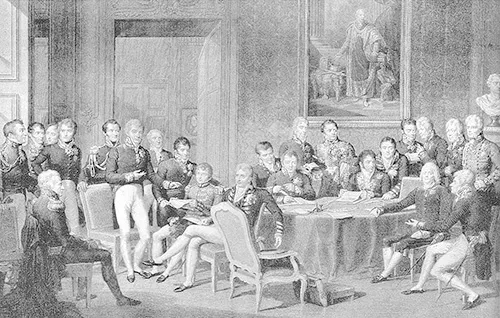
The Final Act of the Congress of Vienna (Annex 16B) created the Central Commission on 9 June 1815. It was to have its headquarters in Mainz and to be composed of representatives of the States bordering the river: the German States (the Länder, which were represented directly in the CCNR: Baden, Bavaria, Hesse, Nassau and Prussia), France and the Netherlands. In practice, the Commission took over the administration established by the Rhine Octroi Treaty.
The Final act of the Congress of Vienna confirmed the principle of freedom of navigation on the Rhine. The Central Commission was tasked with preparing a specific convention governing the implementation of this principle. The work took 15 years, culminating in the Mainz Convention of 31 March 1831.
1831-1868
The Central Commission played an important role in coordinating the work of regulating the Rhine, in the gradual reduction of tolls, the introduction of navigation regulations and the promotion of Rhine navigation.
It acted as a permanent diplomatic conference. It met annually and submitted provisions to its high commissioners, for ratification by the Member States. For example, in 1838 an additional article was adopted governing the transport of dangerous goods on the Rhine.
In 1860, the Commission moved its headquarters to Mannheim.
1868-1918
The Mannheim Act, of 17 October 1868, established:
- the principle that navigation on the Rhine should be free of all levies, and
- the possibility for all Member States of the Central Commission to agree regulations jointly, with every State also having the right to dissent.
The scope of the Central Commission expanded to include all aspects of the prosperity of Rhine navigation. Precise regulations were drawn up, setting out the detailed organisation of Rhine navigation. These were made applicable in national legislation by the Member States. The most important related to the transport of dangerous goods (1868), the police regulations (1869) and licences (Protocol of 4 June 1898), with the texts being regularly updated.
From 1871 the Central Commission became essentially a bilateral German-Dutch organisation, as France ceased to be a member after the Treaty of Frankfurt (1871).
1919-1945
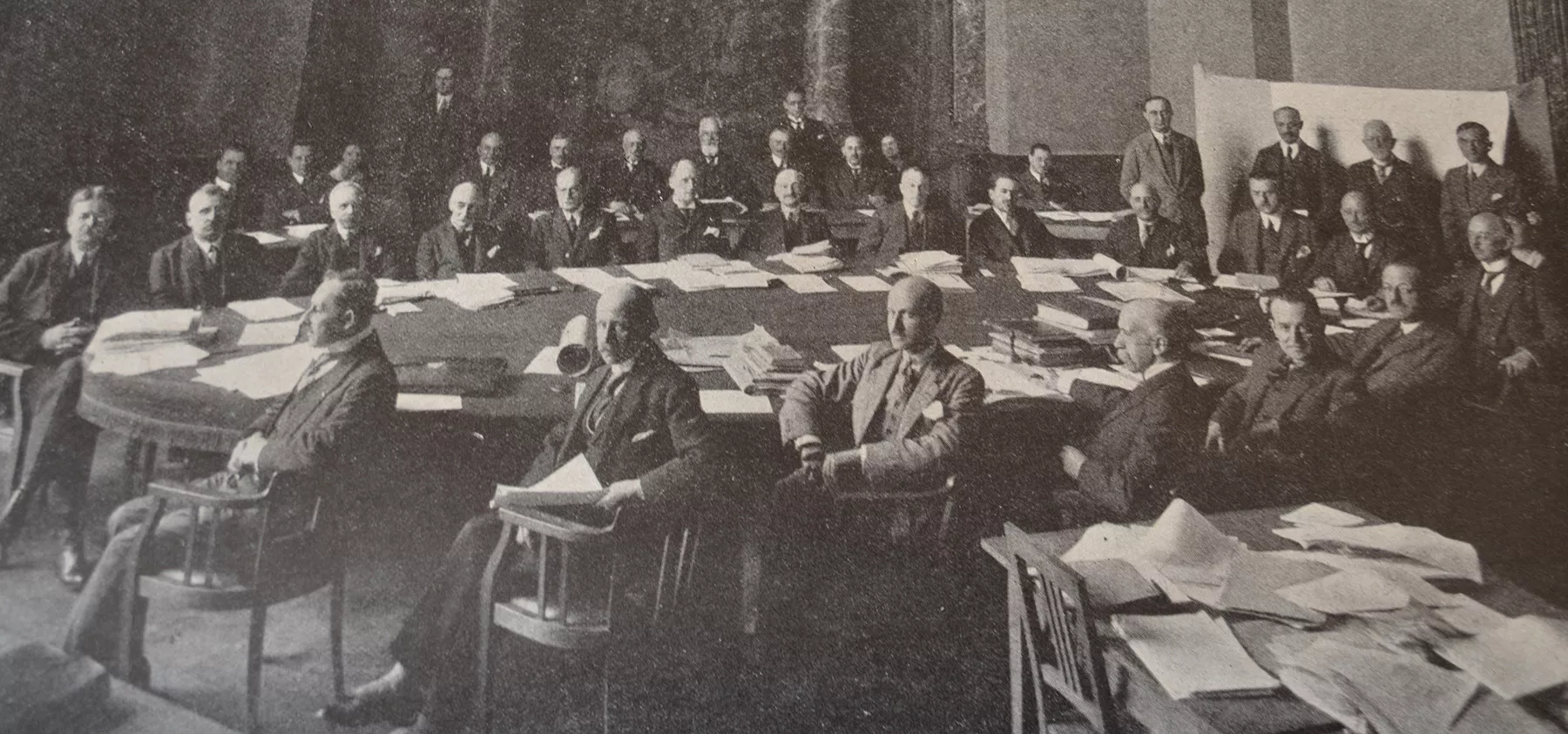
The Treaty of Versailles, of 28 June 1919, brought about a profound reorganisation of the Central Commission and transferred its headquarters to Strasbourg. As well as the return of France, Switzerland, Belgium, the United Kingdom and Italy joined the organisation. Germany, taking the place of the Länder, and the Netherlands were also members.
The Commission was involved in the work to canalise the Upper Rhine. It also monitored the economic situation of Rhine navigation. Work was undertaken to revise the Mannheim Act, leading to a ‘modus vivendi’ which nevertheless fell short of reaching the status of a treaty ratified by all Member States. In the run-up to World War II, Germany and Italy formally withdrew from the organisation in 1936. However, in practice, the German authorities continued to contribute to activities related to police regulations and inspections.
During the war, the Secretariat was transferred to Grenoble, and ceased its activity in 1940.
1945-1980
The CCNR started work again on 20 November 1945. It was made up of American, Belgian, British, Dutch, French and Swiss delegations. Indeed, the United States were members of the Centrals Commission after World War II, leaving in 1961.
The German delegation did not return until 1950. The Central Commission developed a dynamic programme of work in order to reactivate the Rhine corridor. The CCNR set up a number of committees. It also established crew passports and a rations card. Many experts were involved in the work of the Commission. The role of the Secretariat was expanded.
During this period, the Commission was also very involved in simplifying customs formalities. It also negotiated with the military authorities to remove the military bridges which were hindering navigation. There was increased collaboration with other international organisations, notably with the High Authority of the European Coal and Steel Community (ECSC), and later with the European Commission. Specific agreements were reached on working conditions and social security for Rhine boatmen.
1980-2010
This period is marked by growing European cooperation, which provided solutions to many long-standing issues (customs, etc.). Gradually, the principles and rules governing Rhine navigation were adopted, through a range of procedures, and extended to cover all European inland navigation. The Rhine is an integral part of the European network of navigable waterways, while remaining the most active and most developed area.
The Central Commission increasingly focussed on areas relating not only to the Rhine, but to European inland navigation as a whole. For example, in 2008, the CCNR decided that it would no longer update its regulations on the transport of dangerous goods. Instead, it would apply the regulations contained in the European Agreement concerning the International Carriage of Dangerous Goods by Inland Waterways (ADN), agreed in Geneva on 26 May 2000.
Cooperation with the European Union also intensified during this period. 2003 saw the signature of the first administrative cooperation agreement between the CCNR and the European Commission. It included provision for the systematic exchange of information and regular coordination meetings. The CCNR accepted the European Commission as an observer. In return, the European Commission granted the CCNR observer status within its inland navigation committee.
While the United Kingdom left in 1993, the Central Commission welcomed a number of new observer States, mainly from the Danube Basin, as well as Poland and the Czech Republic.
The sustainable development of inland navigation also became an increasingly important topic during this period, together with the protection of water and the management of waste produced by navigation. Following the ecological disaster caused by the fire at the Sandoz depot in Schweizerhalle, leading to the pollution of the Rhine, the plenary assembly of the CCNR tasked an ad hoc committee with studying “the possibility of introducing international regulations dealing with all the problems involved in disposing of waste produced by Rhine navigation”. Work began on 29 November 1989. It led to the implementation of an innovative international convention which defined the rules for the collection, deposit and reception of waste. The CDNI (Convention on the collection, deposit and reception of waste generated during navigation on the Rhine and other inland waterways) came into force on 1 November 2009 in Belgium, France, Germany, Luxembourg, the Netherlands and Switzerland.
2010 to the present day
From the 2010s onwards, cooperation with the European Union intensified even further. In 2013, a cooperation framework was established between the Secretariat of the CCNR and the Directorate-General for Mobility and Transport of the European Commission (DG MOVE). It sets out the conditions of the cooperation, both in terms of regulatory work and market observation.
In this context, at its plenary session in June 2015, the CCNR, created a European Committee for Drawing up Standards in the Field of Inland Navigation (CESNI). The respective regulations at European and international level, in particular those of the CCNR and the EU, can refer to these standards with a view to their implementation. The Committee brings together experts from the Member States of the CCNR and the EU, as well as observers concerned with inland navigation. The primary mission for CESNI is to draw up standards relating to vessel technical requirements, professional qualifications for personnel and information technologies.
The period since 2010 has also seen a range of anniversaries (200 years of the CCNR, 150 years since the Mannheim Act, 10 years of the CDNI, 100 years since the organisation moved to Strasbourg). These anniversaries have allowed the CCNR to look back on its development over the centuries, while at the same time focussing on the future and the challenges that must be faced. Two strategic documents were adopted: the CCNR Strategy in 2017 and the Mannheim Declaration in 2018.
The Mannheim Declaration, signed by the ministers of the CCNR Member States responsible for inland navigation, reaffirmed the key role of the Central Commission in the face of current and future challenges. The main aspects include:
- the development of clean technologies and reduction of emissions;
- the digitalisation of inland navigation and automated navigation;
- the impact of low water levels on inland navigation;
- the attractiveness of the professions and training;
- the integration into logistic chains.
This period was also marked by economic and health crises. On each occasion, the CCNR was present, ready to work swiftly and efficiently to find solutions and support inland navigation. During the Covid pandemic in 2020, the Central Commission took exceptional measures in order to allow inland navigation to continue in appropriate conditions and to ensure that supply chains were able to function.
Thanks to its long history and acknowledged expertise and its standard-setting role, the CCNR makes a decisive contribution to European transport policy today. Cooperation with the European institutions, the river commissions and the approved organisations allows the Central Commission to pursue its mission not solely in the interest of Rhine navigation, but also of European inland navigation as a whole. History has shown that, on many occasions, the CCNR has been able to adapt its role, renew its missions and deal pragmatically with the questions it has faced.