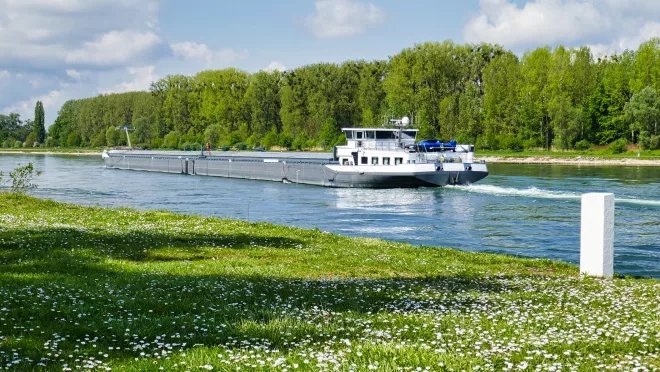

The new report on European inland navigation, drafted by the Central Commission for the Navigation of the Rhine (CCNR) in partnership with the European Commission, has just been published. The executive summary of the report may be found below. The full report can be downloaded in PDF format in English or viewed directly online at https://inland- navigation-market.org/.

Executive summary
In the first half of 2025, inland navigation transport performance in the EU reached 58.7 billion tonne-kilometres (TKM) (-4.6% compared to the same period in 2024). Most European countries saw a decline in transport demand.
On the Rhine, freight transport totalled 135.0 million tonnes, a decrease of -6.0% compared to the same period in 2024. Almost all cargo segments contributed to the decrease. This downward trend can be explained by a combination of macroeconomic and industrial factors, mainly driven by issues encountered in the steel and chemical industries, together with geopolitical factors. In addition, a slight low water period which took place in April 2025 was another factor that contributed to the negative trend.
Coal transport and container transport are the exceptions, the former of which increased by +10.9%. In fact, the increase of coal transport, regarded as temporary, was linked to stock replenishment, low coal prices and a temporary decline in alternative energy production. Nevertheless, the general long- term trend remains downward orientated for this segment. Container traffic benefitted from the resilience of global trade in the first half of 2025 and stabilised somewhat at +0.9%, whilst remaining well below the result of earlier years.
The Danube market faced multiple challenges in the first half of 2025. Attacks on Ukraine’s Danube infrastructure intensified as a result of the continued Russian war of aggression against Ukraine, while macroeconomic and hydrological factors worsened compared to the same period in 2024. As a result, cargo transport on the Danube diminished greatly.
With regard to passenger transport, half-year figures for river cruise traffic on the Rhine in the 2013-2025 period confirm the strong growth trend in this industry as they demonstrate that the river cruise activity on the Rhine has doubled in only 12 years.
On the Danube, an even stronger growth was observed in the number of river cruise vessels and in the number of passengers, especially on the Upper Danube in Germany and Austria.
After having remained at a multiannual average level in the first quarter of 2025, freight rates experienced an increase in the second quarter which was caused by a tendency towards low waters on the Rhine. Oil prices and fuel prices followed a downward trend in the first half of 2025. Fuel prices in inland waterway transport (IWT) are expected to decrease further in the second half of 2025, in 2026 and in 2027, due to an expected decrease in oil prices.
The third chapter of this report focuses on the Netherlands, where the total volume of goods transported on inland waterways (332.4 mio. t) and of container transport (41.0 mio. t) corresponded to the highest EU values in 2024. In addition, the largest goods segment in IWT in 2024 was sands, stones, gravel and building material, followed by the segments of mineral oil and chemical products.
Despite an overall positive trend for liquid cargo, the segment of sand, stones, gravel and building materials has experienced a decrease in recent years. In fact, many goods segments have suffered under unfavourable macroeconomic conditions in Rhine countries since 2022, in the wake of the Russian war of aggression against Ukraine. In addition to this, coal transport has followed a negative trend, with the exception of 2021 and 2022, as a result of the energy transition.
The Port of Rotterdam is not only the largest seaport in the Netherlands but also in the EU. Its hinterland transport is heavily concentrated on the Rhine. In 2024, 142 million tonnes of IWT were registered in the Port of Rotterdam, with 100 million tonnes making up the outgoing traffic (export to the hinterland), and 42 million tonnes corresponding to incoming traffic (import from the hinterland).
We wish you an enjoyable read!
About the Market Observation and Market Insight
The Market Observation and Market Insight reports are respectively annual and biannual publications by the CCNR dealing with the European inland navigation market. The CCNR also publishes thematic reports, the theme of which is defined in consultation with the European Commission. These analyses of the economic situation, which are free of charge, aim to assist strategic decision making in this sector in Europe, by both the profession and firms as well as in terms of transport policy and within administrative authorities. The gathering and analysis of this data by the CCNR has been co-financed by the European Commission since 2005. This fruitful collaboration has enabled the CCNR to extend this activity, which historically it has been carrying on for almost two centuries, beyond the Rhine region to cover all Europe’s navigable waterways.
Other news from the CCNR

Appointment of the new Secretary General of the CCNR
The delegations of the Central Commission for the Navigation of the Rhine (CCNR) have appointed Mrs Hester Duursema as the new Secretary General of the CCNR, with effect from 1st January 2026.
Read the press release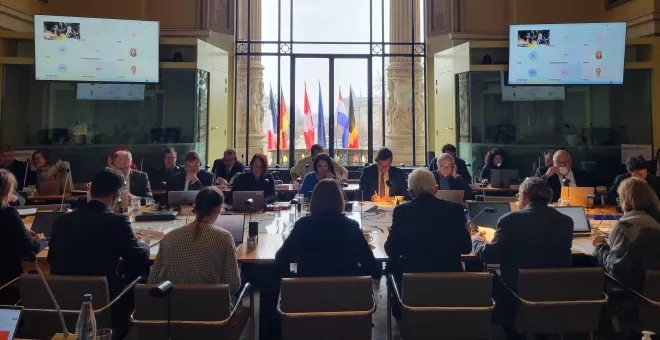
Plenary session of autumn 2025
On 4 December 2025, the Central Commission for the Navigation of the Rhine (CCNR) held its autumn plenary session in Strasbourg.
Read the press release
Priorities for the new Swiss Presidency for 2026-2027
From 1 January 2026 to 31 December 2027, Switzerland will hold the Presidency of the Central Commission for the Navigation of the Rhine (CCNR).
Read the press release