
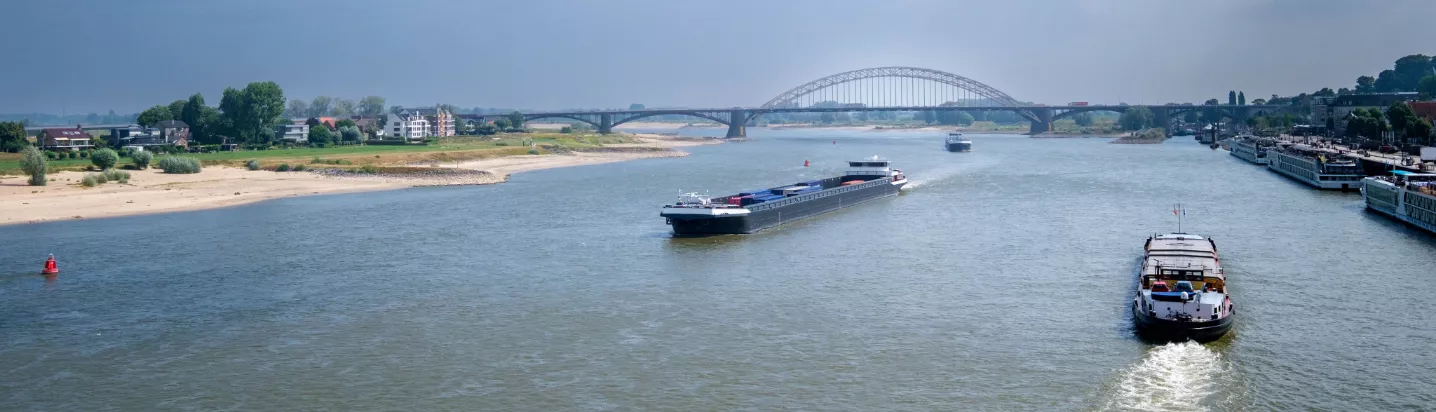
Strasbourg, 10 September 2026 – The Rhine is currently experiencing an exceptional period of low water, putting pressure on Europe’s most important inland waterway. While navigation has never been interrupted, reduced loading capacities are affecting transport of goods across the corridor. Building on its Act Now! initiative, the Central Commission for the Navigation of the Rhine (CCNR) is continuing its efforts along the Rhine, to work on medium- and long-term resilience to extreme low-water events.
Due to a warm and dry winter, insufficient water reserves (including snow and ice), a cumulative rainfall deficit since March, and in some cases very high temperatures during the summer months, water levels have fallen to exceptionally low levels across the Rhine basin this summer. At several gauges along the Rhine, record low-water conditions were observed by mid-August.
Despite these challenging conditions, navigation on the Rhine, although with significantly reduced loading capacities, has never been completely interrupted. The sector continuously adapted its operations to maintain transport wherever possible. This highlights both the severe constraints caused by extreme low water and the ability of the sector to maintain a minimum level of transport under difficult conditions. Rhine navigation remains indispensable for sectors such as the chemical, steel and mineral oil industries, that often cannot be supplied as efficiently by rail or road.
Low water on the Rhine is not a new phenomenon. Following the low-water periods of 2018 and 2022, the CCNR developed its “Act now!” reflection and discussion paper which identified practical measures to improve preparedness and resilience. These include improved water level forecasting, adaptation of logistic chains, fleet adaptation through low draught vessels, addressing infrastructure bottlenecks and strengthening cooperation between stakeholders. Several of these measures have already been implemented or further developed by the shipping sector, industry and waterway administrations within the CCNR member states, allowing to better anticipate and manage the low-water period this year. As a result, preparedness for (extreme) low-water events is significantly higher than it was in 2018.
Building on this work, the CCNR has, in spring 2026, launched the development of a Masterplan Rhine. While the CCNR provides analysis, recommendations and a platform for cooperation, many adaptation measures will require action and investment by a broad range of stakeholders, including public authorities, infrastructure and fleet operators within the CCNR member states.
The CCNR continue to coordinate exchanges between Member States through its Infrastructure and Environment Committee and to monitor the economic impacts through its market observation activities. The situation this year once again demonstrates the importance of coordinated action to strengthen the resilience of the Rhine as a strategic European transport corridor. Despite increasing climate change related challenges, inland navigation remains a reliable, indispensable and environmentally friendly mode of transport.
Les autres actualités de la CCNR

Annual report on inland navigation in Europe: 2026 Edition
Continuing its long and fruitful collaboration with the European Commission, the Central Commission for the Navigation of the Rhine (CCNR) is delighted to present its 2026 Market Observation annual report.
Read the article
Low water this summer and autumn on the Rhine: the CCNR is continuing its efforts to strengthen resilience
Strasbourg, 10 September 2026 – The Rhine is currently experiencing an exceptional period of low water, putting pressure on Europe’s most important inland waterway.
Read the press release